
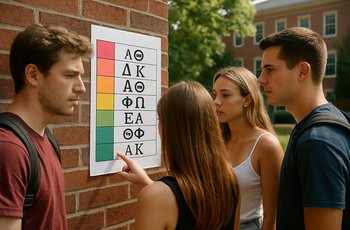
Somewhere between orientation week and your first bid night, someone hands you an invisible spreadsheet. Nobody actually gives it to you - you just absorb it through the air like secondhand smoke. Suddenly you know which houses are "top tier," which ones are "mid," and which ones are apparently one bad semester away from losing their charter. I didn't make the rules. I just lived inside them for four years.
Ranking culture in Greek life is one of those things nobody admits to caring about while simultaneously caring about it more than their GPA. And I say that as someone who definitely checked GreekRank his freshman fall before ever setting foot in a chapter house. I was trying to decode a system that felt like it had been running since before I was born - because honestly, it had been.
Where the Obsession Actually Comes From
Here's the thing about tier lists: they fill a vacuum. You show up to a campus of twenty thousand strangers and within seventy-two hours you're supposed to know which organizations are worth your time. That's a lot of social math to do fast. So people shortcut it. They ask upperclassmen, they check forums, they read whatever ranking thread has the most replies. The information might be two years old and written by someone with a grudge - but it exists, and that's enough.
I remember sitting in my dorm room freshman year with my roommate, a guy named Elliot who had no intention of rushing, watching me annotate a tier list like it was a final exam study guide. He thought I was unwell. In retrospect, he had a point. But I also ended up finding a brotherhood I genuinely loved, so maybe the obsession served some purpose - even if my methodology was completely ridiculous.
The rankings themselves are usually based on a blurry mix of reputation, social events, athlete recruitment, philanthropy visibility, and vibes. Actual vibes. That's the whole rubric sometimes. Sigma Alpha Epsilon at one school might be untouchable, and at the school three hours down the interstate they're on thin ice with their national chapter. The tier list doesn't care about that nuance. It just wants to assign a number.
What the Tiers Actually Measure (and What They Don't)
Look, I'm not gonna pretend tier lists are entirely useless. They do carry some signal. A chapter that's been consistently well-run for a decade probably has that reputation for a reason - strong alumni base, decent leadership structure, members who actually show up for each other. That stuff tends to get noticed on campus over time.
But tier lists are also famously bad at measuring things like: whether the members will actually be your friends, whether the house culture matches yours, whether the chapter has people who will help you when something goes wrong in your life. I had a brother who went through a genuinely rough personal situation junior year. The guys who showed up for him weren't from the "top tier" friendships that recruitment promised. They were guys he'd built actual history with. That doesn't rank on any spreadsheet.
Kappa Kappa Gamma might be listed above Zeta Tau Alpha at your school, and maybe that reflects something real about chapter health, or maybe it reflects the fact that Kappa Kappa Gamma threw a better-attended philanthropy event two semesters ago and people have long memories for arbitrary stuff. Pi Beta Phi could be kinda under-the-radar at one university and completely dominant at another. The tier list treats all of this as fixed truth when it's basically a snapshot of campus gossip with a number attached.
And yet everyone - everyone - checks it. The PNMs check it before recruitment. The current members check it to see where they landed. Alumni check it to see if their chapter still has clout. It's a weird shared fiction that everyone participates in.
The Chapter That Didn't Care About Its Ranking
My chapter had a weird relationship with our ranking. There was a stretch sophomore year where we were hovering solidly in what campus consensus considered "second tier" - not disgraced, not elite, just sort of there. Some of the guys were genuinely annoyed about it. They wanted to know what moves would push us higher. More visibility at events? Better recruitment numbers? A bigger homecoming setup?
Our president at the time - a senior named Marcus who was one of the better leaders I saw in four years of Greek life - basically told the house to stop reading the threads. His argument was simple: the chapters chasing rankings were spending energy on perception that could go toward actual chapter quality. And the chapters with strong internal cultures were the ones that ended up with better rankings eventually anyway, because quality tends to be visible on a campus even when you're not actively performing it.
He was right, and also we all kept reading the threads. Human nature is stubborn like that.
But his point stuck with me, and I think it explains why ranking culture is both unavoidable and kind of a trap. The obsession makes sense as an information-gathering tool when you know nothing. It stops making sense when it becomes a goal in itself - when a chapter is more focused on moving up a list than on actually being something worth ranking.
Why It's Not Going Anywhere
Ranking culture will outlast every reform effort, every values-based recruitment push, every administration memo about fraternity and sorority life. It's not going anywhere because status hierarchies are older than Greek life by about several thousand years of human history. People categorize. They rank. They argue about where Sigma Chi belongs relative to Delta Tau Delta with the same energy they'd argue about anything else that matters to them.
What changes, hopefully, is the weight you give it. The freshmen who arrive on campus and treat the tier list as a fixed map of reality are setting themselves up for a weird four years. The ones who use it as a loose first filter and then actually talk to people - go to events, sit through recruitment conversations, trust their read on a room - tend to end up somewhere that fits.
And the chapters that are genuinely good at what they do usually don't need to check their ranking. They're too busy doing the thing. Which is honestly the most annoying part of the whole system - the people least obsessed with rankings tend to end up with the best ones. Campus is nothing if not ironic.