
There's a piece from the Collegiate Times making the rounds right now with a pretty blunt premise: your For You page has been lying to you about what college actually looks like. And honestly, as someone who graduated in 2024 after four years deep in fraternity life, I read it and felt something. Not surprise. More like the specific exhaustion of watching a problem you lived through finally get a headline.
The article's core argument is simple. Students show up to campus having built their expectations from a carefully curated feed of highlight reels - football Saturdays, perfectly lit dorm rooms, social events that look like they were choreographed. And then reality hits. The dining hall is chaos, your roommate is a stranger, and nobody is handing you a social life in a gift bag. The gap between the TikTok version of college and the actual version is apparently wide enough to cause real problems for incoming students. Loneliness, misaligned expectations, the whole thing.
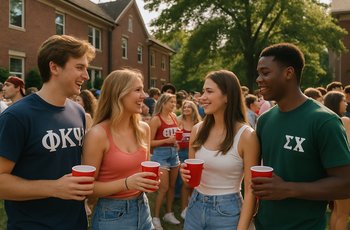
What the article doesn't say - but absolutely should - is that Greek life gets hit by this exact same distortion, maybe harder than anything else on campus.
The Feed Version of Greek Life Is a Specific Fantasy
I remember one of my pledge brothers telling me he rushed our chapter because of a video he saw online. Big house, brothers who looked like they had it figured out, some kind of tailgate with a crowd that seemed to contain every person he'd ever want to know. He was not wrong that the video was real. He was very wrong that it was representative.
What the video didn't show was the Tuesday night chapter meeting that ran two hours over because nobody could agree on the philanthropy event budget. It didn't show the group chat at 11pm arguing about who forgot to return the folding tables. It didn't show the brother who was going through something hard and needed people to actually show up for him - not for content, just for him.
Social media doesn't lie exactly. It just selects. And what it selects for is the 45 minutes of any given Greek event that looks the most like what you already imagined Greek life to be. The other 90% - the logistics, the interpersonal friction, the actual work of being in an organization - gets cropped out.
The Collegiate Times piece talks about how FYP content creates unrealistic expectations about college broadly. But for Greek life specifically, the consequences are concrete. Guys rush Sigma Alpha Epsilon or Kappa Sigma or wherever expecting a social shortcut and bounce when they realize membership requires actual investment. Sorority women go through recruitment expecting the version of Delta Delta Delta or Zeta Tau Alpha they saw in a recruitment video, and then feel like something went wrong when the experience is more complicated and more human than that.
This Isn't a New Problem, Just a Louder One
Look, expectation gaps in Greek life are not new. Before TikTok it was word of mouth, movies, older siblings who made everything sound cooler in retrospect. But the scale of it now is different. An incoming freshman in 2024 has probably watched hundreds of hours of Greek life content before they ever step foot on a campus. That's not an exaggeration. The algorithm is relentless and it knows what you're interested in.
And the content that performs best is not, shockingly, the nuanced stuff. Nobody's going viral with a video about the chapter member who stepped up to help a brother through a rough semester. Nobody's getting a million views on the Panhellenic council working through a genuine conflict between chapters. What gets clicks is aesthetic, it's spectacle, it's the version of Greek life that feels aspirational from a distance.
So chapters - and I watched this happen in real time - start producing content that matches what performs. Which means they're not just failing to correct the distortion, they're actively feeding it. It becomes a loop. The content sets expectations. Chapters respond to the content expectations. And the gap between the real experience and the advertised one keeps growing.
What Actually Gets Lost in That Gap
Here's the thing that bugged me most reading this article. The Collegiate Times is right that the FYP warps expectations about college. But the deeper problem is what gets filtered out in the process.
The stuff that actually made my fraternity worth four years of my life was never going to trend. It was boring, in the best way. It was a brother who drove me to an early morning appointment without asking why. It was a chapter that had a genuinely uncomfortable conversation about how we were treating our pledges and then actually changed something. It was elections where someone lost and handled it with more maturity than I expected, and that told me something real about the people I was surrounded by.
None of that has a good thumbnail. None of it gets saved or shared. It just exists in the actual texture of membership, which you only find out about after you're already in it.
The Collegiate Times article frames the FYP problem as a mental health and adjustment issue, which is fair. But for Greek life it's also a retention and culture issue. When the people joining your chapter are chasing a version of it that doesn't exist, you end up with members who disengage the second the reality doesn't match the reel. And that's not a recruitment problem. That's a perception problem that starts way before bid day.
I'm not gonna sit here and say chapters need to stop posting content or that social media is ruining Greek life. That's not the point and it's also just not how any of this works. But there's something worth sitting with in that Collegiate Times piece - the idea that the most influential thing shaping how students understand college, including Greek life, is an algorithm that has no interest in accuracy and every interest in engagement.
That should make chapters think harder about what they're putting out. Not for optics. Just because the gap it creates tends to cost them the members who would've actually stuck around.