
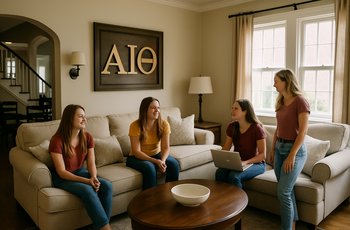
I've walked through a lot of houses. Fraternity houses, obviously - that's my world - but also plenty of sorority chapter houses over the years, usually for study halls, mixers, or just dropping someone off after a late-night campus event. And every single time, I walk away thinking the same thing: the way sorority housing works is genuinely fascinating, and almost nobody outside of Panhellenic actually understands how it functions day to day.
Not in a voyeuristic way. In a logistical, structural, deeply human way. Living with that many people, under one roof, with shared rituals and shared expectations and a house mom somewhere down the hall - that's a specific kind of life that deserves more honest conversation than it usually gets.
The Scale of It Is Hard to Grasp Until You See It
When I say "a lot of women," I mean a lot. Some of the bigger chapters at schools like the University of Alabama or the University of Arkansas are housing 50, 60, sometimes closer to 80 women in a single building. That's not a dorm. That's not an apartment complex. That's a living, breathing organism with its own culture, its own rhythms, its own unwritten rules about kitchen etiquette and quiet hours and who controls the thermostat.
From an IFC perspective, we think our fraternity houses have strong internal culture. And some of them do. But sorority housing tends to be run tighter. There are house directors - sometimes called house moms, sometimes given a more formal title depending on the national organization - who live on premises and serve as a combination of den mother, facilities manager, and institutional memory. Delta Delta Delta, Kappa Kappa Gamma, Pi Beta Phi - most of the major nationals have specific standards these directors have to meet. That's not nothing. That's actual infrastructure.
The physical spaces are different too. The common areas in a well-maintained sorority house feel intentional in a way that most fraternity common areas frankly don't. There are photos of pledge classes going back decades. There are composite boards that track membership over time. There's a sense of continuity that you can actually feel when you stand in the room. Brotherhood is something we talk about a lot on the IFC side, but I'll be honest - some of these houses wear their sisterhood more visibly than we do.
The Pressure Nobody Talks About
Here's the thing though. Living in that environment comes with a specific kind of pressure that I don't think gets acknowledged enough outside of Greek women's spaces.
You're not just living with your friends. You're living with your chapter. That's a different thing. Your roommate might also be on your standards board. The woman across the hall might be evaluating your behavior in a bid meeting next fall. The relationships are layered in ways that most residential living situations aren't, and that creates friction points that have nothing to do with who left dishes in the sink.
Chapters like Alpha Chi Omega and Zeta Tau Alpha - organizations with thousands of members nationally - have internal processes for conflict resolution, academic accountability, and member conduct that run parallel to whatever the university's own systems look like. When you live in the house, you're inside all of that simultaneously. You can't go home and decompress from chapter drama if chapter drama is also where you sleep.
I've heard this described by women I know as both the best and the hardest part of house life. The closeness is real. The intensity is also real. Both things are true at the same time.
What It Actually Builds
Honestly, the alumni piece is where this all starts to make more sense to me.
On the fraternity side, we talk constantly about the brotherhood that carries beyond graduation - the alumni network, the letters you share with guys you've never met, the Sigma Chi or Kappa Sigma handshake that opens a door twenty years later in a city you're new to. That stuff is real and I'd defend it to anyone. But sorority housing creates something that's a little different. It creates shared physical memory.
When a Kappa Kappa Gamma alum comes back to her chapter house for homecoming, she's walking into a space she actually lived in. She knows which stairs creak. She knows what the kitchen smells like on Sunday mornings. She can point to a window and tell you a specific story about a specific night that mattered to her. That's a different kind of institutional bond than what you get from shared ritual alone. It's embodied in a way that's hard to replicate.
Fraternity houses can do this too, obviously. But a lot of fraternity housing is older, less maintained, more chaotic in its layout and use. The sorority chapter houses I've been in that are well-funded and nationally supported tend to hold that history more intentionally. There are archives. There are traditions around specific rooms or spaces. There's a curator's approach to the physical space that I think produces a different relationship to legacy.
That's not a knock on fraternity housing - it's just a real difference, and pretending it doesn't exist doesn't help anyone.
The Stuff Worth Paying Attention To
If you're a prospective member trying to figure out if you want to live in a chapter house, a few things are worth actually looking at beyond the obvious stuff like room size and meal plans.
- How long has the house director been there? Turnover in that role is a signal. Chapters with long-tenured house directors tend to have more stable internal cultures.
- What are the actual live-in requirements? Some nationals mandate that members live in the house for at least one year. Others don't. The policy affects the chapter's culture more than most people realize going in.
- Look at the composites. Not in a weird way - just look at them. A chapter that maintains its history and displays it with care is usually a chapter that takes membership seriously in the longer arc.
- Talk to older members and recent alumnae, not just current members who are in recruitment mode. Ask what they'd do differently about the housing decision.
Living in a sorority house is kinda its own education. Not the academic kind - the other kind. The kind where you figure out how to share space with people you didn't choose, care about something larger than yourself, and build relationships that outlast the four years you're actually there. That's the tradition underneath all the visible tradition. And from where I'm standing, it's worth taking seriously.