
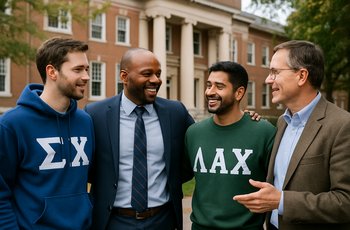
Nobody sat me down junior year and said, "Here's how Greek life will actually help your career." It just kind of happened, quietly, over time, in ways I didn't recognize until I was already out the other side. I joined Alpha Chi Omega for the sisterhood - full stop. But the professional network I stumbled into? That came from the fraternity guys across the hall at every study hall, every philanthropy event, every awkward co-ed service project. And I genuinely didn't see it coming.
I'm a sorority alumna, so you might be wondering why I'm writing about fraternity brothers at all. Fair question. But here's the thing - Greek life at most schools isn't siloed the way outsiders imagine it. You share spaces. You run events together. You end up knowing the Sigma Chi chapter president better than you know half your own pledge class, sometimes. That cross-organization proximity is something nobody talks about when they're selling you on recruitment, and it matters more than almost anything else in the long run.
The Accidental Part Is the Important Part
My senior year roommate and I used to joke that Sigma Alpha Epsilon had better alumni programming than our own chapter. That's not a dig at Alpha Chi Omega - our alums were incredible - it's just that SAE's network was enormous and weirdly accessible. One of their brothers, a guy I'd done Habitat for Humanity builds with three semesters in a row, texted me out of nowhere four months after graduation. His firm in Chicago was looking for someone with my background. He'd thought of me. Not because we were close friends, exactly. Because we'd worked alongside each other on something real, something that wasn't a social event, and he knew how I operated.
That's the mechanism nobody names. It's not the formal "alumni networking event" model. It's not LinkedIn messaging someone because they went to your school. It's this quieter thing - someone who watched you haul lumber and argue about spreadsheets for a philanthropy budget remembers you when a seat opens up. You didn't engineer that. You just showed up, repeatedly, for something you actually cared about.
I've talked to enough other Greek alumni now to know this isn't unique to my experience. A woman I know from Delta Delta Delta told me her first job offer came through a Pi Kappa Alpha brother she'd co-chaired a mental health awareness event with. Another friend, Kappa Kappa Gamma, got a referral from a Sigma Chi guy she'd been on the philanthropy council with for two years. Over and over again, the pattern is the same: sustained, low-pressure, task-oriented contact. Not networking. Just working together on stuff that mattered.
What Makes This Different From Normal Networking
Honestly, I think the reason this works so well is that it bypasses every awkward thing about traditional networking. Nobody is performing. Nobody is handing out business cards at a mixer hoping to score a contact. You're just trying to get a fundraiser organized, or figure out how many volunteers you need, or negotiate the Greek Week budget with someone who clearly has a different vision than you do.
That's real. People remember real. They remember who stayed late, who actually communicated when something went sideways, who didn't throw anyone under the bus when the event went badly. Those are the exact same qualities employers are trying to assess in an interview, and your fraternity brother co-worker already has two years of data on you.
There's also a trust element that's hard to replicate elsewhere. Not blind loyalty - that's a different and much more dangerous thing - but a baseline credibility. When that SAE brother texted me about the Chicago job, he wasn't taking a risk on a stranger. He was vouching for someone he'd seen perform under actual pressure. His reputation was on the line too. That's a real endorsement, not a LinkedIn recommendation someone wrote in four minutes.
The Part Nobody Plans For
Here's what I want to be direct about: this doesn't happen automatically just because you joined a sorority and occasionally attended Greek-wide events. The people who walked away with these connections were the ones who actually showed up to the collaborative stuff. The philanthropy councils. The inter-Greek leadership boards. The joint service projects. Zeta Tau Alpha women who spent three years doing philanthropy work alongside Pi Beta Phi and Kappa Sigma guys have a completely different alumni web than someone who kept Greek life siloed to chapter events.
It also helps if you treated those relationships like relationships and not transactions. I know that sounds obvious, but you'd be surprised how many people approach even informal Greek networking with this weird transactional energy - always working an angle. That's detectable. It doesn't build the kind of trust that produces a job referral two years later.
The people who benefited most from this accidental network were, almost without exception, genuinely curious about the people they worked alongside. They knew the names of the fraternity brothers' majors, their hometowns, what they were stressed about during finals. Not because they were strategic about it. Because they were actually paying attention.
Look, I can't tell you this is gonna replicate itself the same way at every school, in every chapter, across every combination of Greek organizations. Campus culture matters. Chapter culture matters even more. Some fraternities are closed off in ways that make real cross-organizational relationships basically impossible. Some sororities discourage their members from getting too involved in inter-Greek stuff in ways I think are genuinely shortsighted.
But if you're in an environment where that collaboration is possible - and most schools have at least some version of it - the professional returns are real. Not because someone designed a program to produce them. Precisely because nobody did.