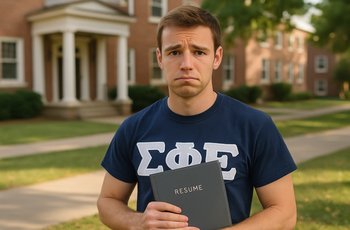

I almost didn't rush. My first semester freshman year, I was convinced Greek life was for people who needed a social structure handed to them. I had my friend group, I was figuring out college on my own terms, and honestly the whole thing looked exhausting. But I also bombed two midterms that semester and finished with a 2.6 GPA - and I had no idea yet how much that number was going to matter.
Here's the thing nobody really tells you during orientation: your first semester GPA doesn't just affect your academic standing. It sets a baseline that follows you into almost every opportunity you'll try to access for the next four years. And if you're thinking about Greek life at any point - freshman year, sophomore year, whenever - that number is more relevant than most recruitment conversations let on.
The Baseline Problem Is Real
When I rushed Sigma Chi my sophomore year, I had to disclose my GPA. Most chapters have a minimum - usually somewhere between a 2.5 and 3.0 depending on the chapter and school. I squeaked by. But a few guys I knew from my dorm didn't even get to that conversation because their first semester had tanked their cumulative average enough that no amount of recovery had fixed it yet. They weren't bad students. They just had a rough start and the math hadn't caught up.
This isn't unique to Greek life either. Study abroad programs, honors societies, undergraduate research positions, RA jobs, internships - a lot of them calculate your GPA cumulatively. That 2.6 I pulled first semester dragged my cumulative average down for almost two full years even after I started getting 3.4s and 3.6s each semester. The hole is just deeper than it looks when you're in it.
I've talked to guys in my chapter who transferred in or came in with strong first semesters and the difference is visible in what they could access. One brother in Sigma Chi with me had a 3.8 after his first semester and just never stressed about academic eligibility - for anything. It wasn't that he was smarter. He'd just protected that baseline.
Why First Semester Specifically Is Different
A lot of people treat first semester like a warmup. You're adjusting, finding your people, figuring out how college classes actually work. And sure, some adjustment is real. But the academic structure of first semester is usually more forgiving in terms of workload - and yet GPAs still drop because nobody's watching and nobody's holding you to anything.
When I joined a chapter later, I noticed something. Chapters that take academics seriously - and some genuinely do - build in accountability structures from the start. Study hours, GPA check-ins, academic chairs who actually do something. I'm not saying Greek life is some academic rescue program. It isn't. But the structure exists, and for a lot of people it works better than the total freedom of freshman year with no one paying attention.
The guys who struggled most academically in my chapter were almost always the ones who came in with a damaged GPA they were trying to dig out of. Not because Greek life hurt them - they'd done the damage before they got there. The chapter just couldn't fully offset a year and a half of compounding math.
Honestly, that's a design flaw in how Greek recruitment works too. Most chapters do rush in spring of freshman year or fall of sophomore year. By that point, your first semester grade is already locked. There's no do-over. You're either coming in with a number that opens doors or one that requires explaining.
What Recovery Actually Looks Like (And How Long It Takes)
I want to be straight with you: you can recover from a bad first semester. I did. But it's slower than people expect and it costs you things along the way.
Say you finish first semester with a 2.5. To get your cumulative GPA to a 3.0, you need to average around a 3.3 or higher for several consecutive semesters. That's doable but it requires being consistently above average for a long stretch while also doing everything else college asks of you. And the longer it takes, the more opportunities you miss with a sub-3.0 on your transcript in the meantime.
I've seen this play out with sorority recruitment too. A friend of mine was going through Pi Beta Phi recruitment at a school in the SEC and she was genuinely a good fit for the chapter. But her GPA was just under their minimum and the chapter's hands were kind of tied. She ended up with a different chapter that had a lower threshold - and she's happy there - but the point stands. That first semester number had taken a specific option off the table.
Some chapters will make exceptions for upward trends. If you went 2.3 to 2.8 to 3.1 they can see the trajectory. But a lot of chapters don't have the flexibility to make those calls - their minimums are set by their nationals, like what Delta Delta Delta or Zeta Tau Alpha or Alpha Chi Omega require at the national level regardless of what a local chapter might prefer. You can't charm your way past a hard floor.
The Part That Actually Surprised Me
When I finally got into Sigma Chi and started paying attention to how the chapter ran, I realized grades came up way more often than I expected. Not in a lecture-y way - just practically. Brothers asking each other what their GPA was before applying for something. Older members giving advice about which professors graded hard. An academic chair who sent out reminders before midterms that weren't optional.
But here's what nobody said out loud: the guys with strong academic foundations from early on just had more bandwidth. They weren't spending mental energy on whether they'd qualify for the next thing. They could focus on getting the most out of the chapter, out of their major, out of everything.
I came in as a skeptic and I still have friends who never went Greek and are doing just fine. I get the skepticism. But from where I sit now - having seen both sides - the one thing I'd go back and tell freshman me isn't anything about rushing or not rushing. It's that the GPA you build in those first four months is the foundation everything else gets stacked on top of. And foundations are a lot harder to rebuild than they are to build right the first time.