
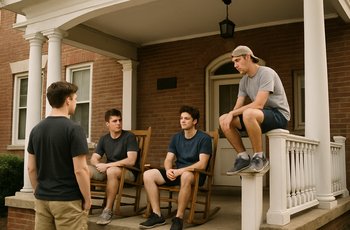
Nobody hands you a manual when you go Greek. You get a bid card, maybe a handshake, and then you're just kind of expected to figure out the rest by watching and occasionally embarrassing yourself. I did plenty of both. And looking back from the other side of graduation, there's a pretty long list of things I wish someone had just said out loud during my first semester instead of letting me learn them the hard way.
This isn't about hazing or dues or whatever controversy is trending on Greek Twitter this week. This is about the quieter stuff - the social architecture, the unspoken expectations, the things that separate the guys who thrive in a chapter from the ones who spend four years feeling slightly out of place. It took me longer than I'd like to admit to learn most of it.
Your Reputation Inside the House Matters More Than Your Reputation on Campus
Here's the thing freshmen get completely backwards. They spend so much energy worrying about how they look to other organizations, to the sororities on their street, to the random students who see them at events. Meanwhile they're not doing the dishes when it's their turn and blowing off chapter meetings for reasons that would embarrass them if they said them out loud.
The brothers who went on to run the chapter - the ones who became president or social chair or philanthropy lead - they weren't the guys who showed up loudest at events. They were the ones other brothers wanted to be around on a random Tuesday. That sounds simple but apparently it's not, because I watched a lot of talented guys completely miss it.
Sigma Alpha Epsilon guys I knew at a neighboring school had this phrase they used internally: "Tuesday test." Would you want to hang out with this person on a Tuesday with nothing going on? That's the whole filter. If the answer is no, no amount of being seen at the right events fixes it.
Relationships With Other Organizations Are Actually Relationships
When I was a pledge, I thought Panhellenic relationships were mostly logistical. You partner with a sorority for philanthropy, you do a mixer, you check the box. I was wrong, and I paid for it in small embarrassing ways for about two years.
The older guys in my chapter had actual friendships with women in Delta Delta Delta and Kappa Kappa Gamma that went back years. They called each other by name. They knew who was studying for the MCAT and who was struggling with their thesis. When something went sideways at a joint event - and something always goes sideways - those relationships were the reason it got fixed quietly instead of becoming a whole thing.
Freshmen tend to treat these connections like transactions. Show up, be charming for a few hours, disappear. That's not a relationship. That's a cameo. And everyone notices the difference, even if they don't say it to your face.
Same goes for your relationships with the Interfraternity Council, with campus organizations you collaborate with, with the housing staff in your building if you live in the house. Treat every repeated interaction like it's building something, because it is - whether you mean it to or not.
The Guys Who Are "Just Here for the Brotherhood" Usually Aren't
I mean this gently because I was guilty of a version of it my sophomore year. There's a type - and you'll recognize them - who talks constantly about how much they love the brotherhood, how the chapter is family, how they'd do anything for the letters. And then when committee work needs to get done, when someone needs help moving, when a less exciting obligation comes up, they're mysteriously unavailable.
Brotherhood isn't a feeling. It's a set of choices you make repeatedly over four years, mostly when there's nothing in it for you. I had a brother in Kappa Sigma who drove two hours round trip to help a pledge he barely knew move out of a bad housing situation. No fanfare, no story about it at chapter. Just did it. That guy had more credibility in our house than almost anyone I can think of, and he wasn't even in a leadership position.
If you're genuinely there for the brotherhood, you don't have to say it that often. It shows up in the record.
Nobody Remembers What You Said. They Remember How You Made Things Go
Honestly, the biggest adjustment for most freshmen isn't social - it's operational. Greek life runs on a lot of moving parts and most of them are being managed by 20-year-olds who are also in class full time and figuring out their own lives. When you step up and make something easier for those people, they remember you. Not in a transactional "I owe you" way. Just in the way that trust builds.
I helped with logistics for a philanthropy event my freshman year - nothing glamorous, mostly spreadsheets and emails - and the social chair at the time, a senior I barely knew, vouched for me in a chapter vote about eight months later. I genuinely don't think he even consciously connected those things. He just had a positive impression of me because I had made his life easier once.
That's how a lot of chapter politics actually works. Not scheming, not positioning. Just having a track record of making things go smoothly when it was your job to make things go smoothly.
Nobody tells freshmen this stuff at bid day. They're too busy celebrating, which is fair - bid day is genuinely fun. But somewhere between bid day and initiation, someone should pull the new guys aside and explain that the chapter is basically a small organization with a culture that either sustains itself or slowly falls apart, and every member is either adding to it or quietly draining it. There's no neutral. You're doing one or the other.
Four years goes fast. You get maybe eight semesters to figure out which one you're doing.