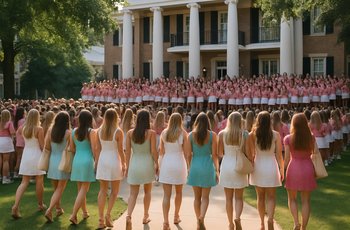

A Pennsylvania college just suspended all Greek life activities after antisemitic and sexist comments surfaced within their chapters. No vague policy violations, no "hazing-adjacent" gray area stuff - actual documented antisemitic and sexist remarks. And honestly, sitting here as someone who spent four years in a fraternity and genuinely loved it, that kind of news still hits like a gut punch. Not because it's shocking. Because it's so preventable.
The school hasn't released every detail publicly, which is pretty standard when administrations are in scramble mode. But the broad strokes are clear enough: Greek organizations made the news for the worst possible reasons, and now every chapter on that campus - including ones that probably had nothing to do with it - is frozen. Events canceled. Recruitment paused. Brotherhood and sisterhood on hold, indefinitely. That's how this works. One chapter's bad actors become everybody's problem.
The Suspension Isn't the Punishment. The Publicity Is.
Here's the thing about suspensions like this - the formal administrative penalty is almost secondary. Your school can lift a suspension eventually. You can return from probation. But the Google search results? Those stick around. Future members will find this story. Parents will find this story. And in an era where Greek life is already fighting an uphill reputation battle on basically every campus, adding "antisemitic comments" to your chapter's history is the kind of thing that echoes.
I've watched chapters at my own school go through smaller versions of this. A screenshot gets out, a story gets posted somewhere, and suddenly the IFC is in emergency meetings at 11pm on a Tuesday. The brothers sitting in that room who weren't involved in whatever happened are just as stressed as anyone - maybe more, because they're the ones who have to figure out how to salvage something they cared about and didn't break. It's exhausting in a way that's hard to explain to anyone outside Greek life.
And look, I'm not here to play victim for fraternities and sororities broadly. The reason suspensions like this one happen is because real things were said by real people in those organizations. That's not a misunderstanding or bad optics or a dean overreacting. That's a genuine failure of chapter culture.
Culture Comes From the Top - Or It Doesn't Come at All
The hardest conversation to have about any of this is the culture one. Because every chapter president will tell you their organization doesn't tolerate hate speech or discrimination. They'll say it confidently. They'll point to their DEI trainings and their recruitment values and their national organization's policy documents. And some of them are being completely honest. But some of them have no idea what's being said in their own GroupChat.
I'm not joking about that last part. The number of things that happen in the side channels - the smaller group texts, the inside jokes that stopped being funny three years ago, the stuff that gets laughed off as "just the way we talk" - it's genuinely where chapter culture lives or dies. The formal stuff is performance. The informal stuff is truth.
In a well-run chapter, those two things are mostly aligned. The way brothers talk to each other publicly matches how they talk privately because the culture has actually been built that way - through leadership, through accountability, through older members genuinely checking younger ones when something's wrong. I saw this done well exactly once during my time in Greek life, by a Sigma Chi chapter that had the most intentional new member process I've ever witnessed. They were serious about it. Not in a corny way. Just in a we actually mean what we say way.
Most chapters aren't doing that. Most chapters are hoping the bad stuff stays quiet.
What Happens to the Members Who Weren't Involved
This part never makes the news and it probably should. When a whole Greek program gets suspended - like what's happening at this Pennsylvania school right now - there are seniors who just lost their last semester of events. There are juniors who had leadership positions they'd worked toward for two years. There are new members who just joined and are now wondering if they made a massive mistake.
None of those people necessarily did anything wrong. And they're still living with the fallout.
I've talked to people in exactly that position and the feeling is a weird mix of anger, grief, and guilt - even when you have nothing personally to feel guilty about. Guilt by association is real and it messes with you. You start wondering if you should have spoken up about something you heard six months ago that felt off but not quite off enough to make a thing out of. That's a brutal headspace to be in during what's supposed to be some of the best years of your life.
The chapters that contributed to this mess at that Pennsylvania school don't get to feel that weight the same way the innocent bystanders do. And that asymmetry is one of the genuinely unfair parts of how organizational accountability works.
Suspensions are blunt instruments. They don't do surgery - they do crowd control. And sometimes crowd control is exactly what a situation requires. But let's not pretend it fixes the underlying thing. Whatever made it acceptable within that Greek community to say what apparently got said - that doesn't disappear because recruitment is paused for a semester. That requires actual reckoning. Whether it happens is a completely different question.