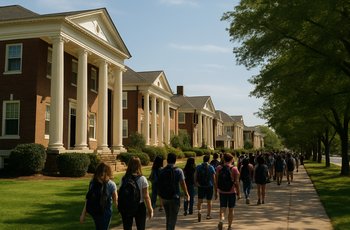

Ole Miss Greek life just added over 3,000 new members. Three thousand. That's not a recruitment cycle, that's a population migration. For context, some entire universities don't have 3,000 students total, and Ole Miss just absorbed that many people into sororities and fraternities in a single recruitment season. If you're not impressed by that number, you might need to recalibrate your sense of scale.
I graduated in 2024 from a school with a solid Greek system - not tiny, not Ole Miss. And I remember bid day like it was last week. The energy, the chaos, the people crying because they got into their top chapter, the people crying for the opposite reason. Multiply whatever I experienced by a factor that makes my head hurt, and you're starting to get close to what Ole Miss just pulled off.
This Isn't a Fluke, It's a System
Here's the thing about Ole Miss Greek life that outsiders don't always get - this isn't an accident. Schools don't accidentally recruit 3,000 members. That kind of scale requires infrastructure, alumni buy-in, campus culture that actively supports Greek participation, and a recruitment machine that's been refined over decades. Ole Miss has all of it.
The SEC Greek life ecosystem is genuinely different from what you'll find at a northeastern school or a small liberal arts college. I'm not saying one is better. I'm saying they're different species. At Ole Miss, Greek life is woven into the actual identity of the university in a way that's hard to explain unless you've walked through that campus during rush week. The Grove tailgates, the social scene, the networking - it all runs through the Greek system in a way that creates real structural demand for membership.
When demand is that high, chapters get to be selective. When chapters are selective, the competition sharpens everyone's recruitment game. When recruitment improves, more people want in. It's a cycle, and Ole Miss has been riding it for a long time.
What 3,000 Members Actually Means Operationally
Okay so let's talk about the logistical reality here, because I think people gloss over this part. Getting 3,000 new members isn't just a feel-good headline. That's 3,000 people who need to be onboarded, educated, assigned to chapters, integrated into pledge processes, and eventually initiated. That's thousands of individual personalities being matched with chapters that each have their own culture, expectations, and internal drama.
I was in a mid-size chapter - around 80 active members - and just managing that felt like running a small nonprofit with worse accounting. The idea of coordinating recruitment across enough chapters to absorb 3,000 people simultaneously is honestly kind of mind-bending. Someone at Ole Miss's Panhellenic and IFC offices deserves a very long nap.
There's also the financial angle. New members mean new dues. New dues mean chapters have actual budgets to work with. That translates to better facilities, better programming, better philanthropy events. The chapters at Ole Miss aren't scraping together money for a barbecue - they're operating with resources that most chapters at smaller schools would find genuinely shocking.
The Part Nobody Wants to Say Out Loud
Look, I'm gonna be honest about something. Numbers like 3,000 new members generate a lot of excitement, and they should. But scale also creates pressure. Pressure to maintain a reputation. Pressure to keep chapters running cleanly when you have that many personalities under one Greek umbrella. Pressure on new members who might feel like a number in a large system rather than a person in a community.
I've seen what happens when chapters grow faster than their culture can absorb. The brotherhood or sisterhood that made the organization worth joining in the first place gets diluted. You stop knowing everyone's name. The older members don't connect with the new ones. The thing that made it special starts to feel like a brand instead of a community.
Ole Miss has clearly figured out how to sustain growth without that collapse - because this isn't a one-year spike, this is a pattern. But it's worth saying that 3,000 new members is only a good story if those 3,000 people actually feel like they joined something real. If they just got a bid and a bid day photo and then spent the next year feeling like a stranger at their own chapter events, the number means nothing.
Some of the best Greek life moments I had were in a room of maybe 15 people who all knew each other well enough to be brutally honest. That's harder to replicate at scale. Not impossible - but harder.
Still, Give Credit Where It's Due
I'm not here to be cynical about this. Ole Miss doing recruitment at this level is impressive by any measure. It says something real about the health of Greek life at that school - that students are choosing it, returning alumni are supporting it, and the administration hasn't actively dismantled it the way some schools have in recent years.
At a time when Greek life is under a microscope nationally - and let's be real, often for legitimate reasons - a school pulling in 3,000 new members is a signal worth paying attention to. It means students still see value in what these organizations can offer. The mentorship, the professional networks, the social infrastructure, the sense of belonging to something that existed before you got there and will exist after you leave.
Zeta Tau Alpha, Sigma Chi, Kappa Kappa Gamma, Sigma Alpha Epsilon - these organizations have chapters at Ole Miss that are now welcoming fresh classes of members who will spend the next four years building something together. Some of those relationships will be the most important ones of their lives. Others will fizzle out after sophomore year. That's Greek life at any school, at any size.
But 3,000 people just got a shot at it. That's worth noting, even if you're a cynic.