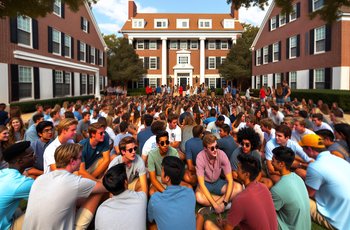

Most Greek life coverage follows a predictable script - big flagship school, drama, suspension, think piece. So when KPLC 7 News ran a segment actually exploring Greek life at McNeese State University, I paid attention. Regional news covering a mid-size Louisiana school's Greek community doesn't happen by accident, and it tells you something real about where the culture is right now.
McNeese isn't LSU. It's not Ole Miss. It's a regional comprehensive university in Lake Charles, and the fact that its Greek community is getting local news coverage - not because of a scandal, but as an exploration - is genuinely interesting to me. That's not the norm. Usually when local TV shows up on a campus, somebody already called the lawyers.
Small Systems Carry Real Weight
Here's the thing about Greek life at smaller schools: the stakes per chapter are completely different. At a school like McNeese, one chapter going on probation or one sorority losing members doesn't get absorbed into a system of thirty-plus organizations. It echoes. I've seen it happen at schools that size - one chapter stumbles, and suddenly Panhellenic is scrambling to hold recruitment numbers together because the whole ecosystem depends on relative balance.
That's not a flaw. That's actually a more honest version of what Greek life is supposed to be. At enormous schools, you can have a chapter operating badly for two or three years before it actually collapses - there are enough members, enough events, enough inertia to keep it going. At a place like McNeese, accountability is more immediate because the margin is thinner.
I spent two years on a Panhellenic council at a school not too dissimilar in size, and the logistical reality is brutal. You're writing recruitment rules for a community where every chapter has maybe thirty to sixty active members. A sorority that loses ten women in a single semester isn't a statistic - it's a crisis. The NPC quota and total system, which already makes my head hurt at scale, becomes genuinely complicated when your total number of PNMs is small enough to fit in a lecture hall.
What the Coverage Gets Right (and Misses)
The KPLC segment frames Greek life at McNeese as something worth exploring - worth understanding. And I think that framing matters more than most people realize. Greek organizations at regional schools often operate without any of the infrastructure that props up chapters at flagship universities. No massive alumni donor networks. No Greek row with house staff. No full-time Greek life professional office with six advisors. What they have is the student members and whatever the national organization provides, which - depending on the chapter - can range from genuinely useful to basically nothing.
What coverage like this tends to miss, through no real fault of a local news team, is the governance layer. The Panhellenic council side. The inter-fraternity council politics. Who's actually making decisions about how recruitment runs, how events get approved, how chapters in bad standing get handled. That's where the real story usually lives at any school, and it's almost never what gets filmed.
I don't blame reporters for that gap. The governance layer isn't visual. It's spreadsheets and bylaws and meetings where four council members argue about whether a chapter's philanthropy event counts toward their service hour requirement. It's not footage. But it's where Greek life either holds together or starts to come apart.
Regional Greek Life Deserves Serious Coverage
Look, there's a version of Greek life that exists only in the national conversation - the Sigma Alpha Epsilon controversies, the Delta Delta Delta recruitment videos going viral, the Pi Beta Phi chapter at some Power Five school making news for something embarrassing. That version gets attention because it's familiar, because the schools are recognizable, because the stakes feel legible to people who didn't go Greek.
But the McNeese version of Greek life is where most Greeks actually live. Smaller chapters at schools that don't have national name recognition, where joining Zeta Tau Alpha or Kappa Sigma or Alpha Chi Omega means something intensely local - it means your community, your campus, your Lake Charles. It's not gonna translate into a viral moment. It doesn't need to.
What it needs is honest coverage that takes it seriously on its own terms. Not as a curiosity, not as a human interest soft story between weather and traffic - but as a real institution with structure and history and internal politics that shape the experience of a significant percentage of that student body.
The KPLC segment is a starting point. I'd want to see the follow-up. What does recruitment actually look like at McNeese this cycle? How is the Panhellenic council handling compliance under NPC's new membership recruitment policies? Are the fraternity chapters affiliated with IFC running a deferred recruitment model or not? Those questions sound dry. They are also the actual story.
Greek life at a school like McNeese is kinda a pressure test for whether the whole model works when you strip away the flagship resources. My honest read - it can work. But it requires a council that knows what it's doing and chapter leadership that's actually present and paying attention. Whether McNeese has that right now, I genuinely don't know. But I'd bet the people running Panhellenic over there could tell you in about thirty seconds.