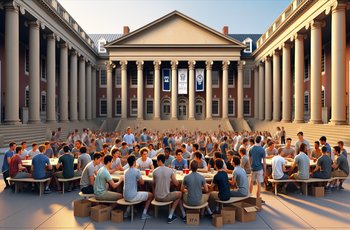
Every few months, some campus newspaper runs a headline that basically amounts to "Is Greek life gonna survive?" and I have to physically stop myself from rolling my eyes into another dimension. The Santa Clara just published their version of this piece - the classic "doomed to fail or hope for the future" framing - and look, I get it. It's a legitimate question. But it's also a question that's been asked approximately nine thousand times since at least 2010, and Greek life is still here. So maybe we need to retire the dramatic binary and actually talk about what's happening.
I graduated in 2024. Four years in a fraternity. I watched chapters get suspended, watched recruitment numbers dip during COVID, watched our own house go through an internal reckoning about what we actually stood for versus what we said we stood for at recruitment events. And through all of it, the question was never really "will this survive." The question was always "who's going to do the work to make it better."
The "Doomed" Argument Misses the Point
Here's the thing about the doom narrative - it treats Greek life like it's one monolithic thing that either lives or dies. It's not. A Sigma Alpha Epsilon chapter at a large SEC school and a Sigma Chi chapter at a small liberal arts college are having completely different experiences. Panhellenic recruitment at a 40,000 student university looks nothing like what's happening at Santa Clara. Lumping all of it into one existential question is like asking whether "restaurants" are going to survive. Some are thriving. Some deserve to close.
The Santa Clara piece raises real concerns about culture and accountability, and those concerns aren't wrong. But framing it as a binary - doom versus hope - actually makes the harder work easier to avoid. If the story is "Greek life might die," then you can just watch from a distance. If the story is "specific chapters in specific places are failing their members and their campuses," then someone has to actually name names and do something about it.
I remember sitting in a chapter meeting my junior year where we were going over a new member education curriculum that felt like it had been written by a risk management lawyer in 1997. Nobody in that room thought it was good. But changing it required someone to care enough to rewrite it, get it approved, and actually run it well. That's boring work. That's not a headline. And that's exactly why it doesn't get covered.
The "Hope" Argument Is Too Easy Too
The other side of this framing bugs me just as much. The "hope for the future" angle usually involves a chapter that planted trees or raised money for a charity and everyone gets to feel good about Greek life for a news cycle. And I'm not dismissing philanthropic work - our chapter had a fundraiser every spring that genuinely mattered to a local nonprofit and I'm proud of it. But charity events don't fix structural problems in how chapters select members, develop them, or hold leadership accountable.
The "hope" framing also tends to center on optics. New diversity initiatives that look great in a press release. Recruitment videos with better production value. Panhellenic Councils updating their websites. None of that is nothing, but it's also not the same as doing the actual hard culture work inside a chapter. Alpha Chi Omega or Pi Beta Phi can have a beautiful Instagram presence and still have a chapter where new members feel isolated and undervalued. The two things are not connected.
Honestly, the most hopeful thing I ever saw in four years had nothing to do with a campus-wide initiative. It was a chapter president at a neighboring school who got up in front of his entire brotherhood and said the way they'd handled a situation with a member who was struggling had been wrong - and he explained specifically how. No PR framing. No vague apology. Just accountability in a room full of people who already knew the story. That stuck with me. That's what culture change actually looks like up close.
What Santa Clara Gets Right Without Knowing It
The fact that The Santa Clara is even asking the question is, weirdly, a decent sign. Apathy would be worse. Campuses where nobody is questioning whether Greek organizations are living up to their stated values are the ones where things quietly rot. The chapters that scare me are not the ones under scrutiny - it's the ones that have figured out how to look fine while nothing meaningful is happening internally.
Greek life at mid-sized private universities like Santa Clara operates in a different context than the flagship state school experience. Smaller campuses mean higher visibility, tighter alumni relationships, and less room to hide. That cuts both ways. Chapters that are genuinely doing good work get recognized faster. Chapters that aren't can't just blend into a huge Greek row and go unnoticed.
So is Greek life doomed? No. Is it automatically fine because it's survived this long? Also no. The chapters that are going to be worth anything in ten years are the ones where someone right now - some junior who got elected president for the wrong reasons and grew into the role anyway, some new member educator who actually rewrote the curriculum - is doing genuinely unglamorous work that doesn't make the school paper.
That's not a hopeful ending. That's just what it actually takes.