
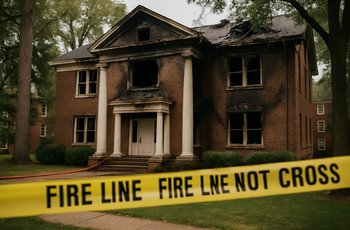
So Alpha Zeta had a fire. Fire departments responded, the house got damaged, and now everybody's doing that thing where they shake their heads and say something vague about fraternity houses being old. And look, I get it. But I want to push back on the idea that this is just some random unfortunate event. Because it's not. It's a pattern, and Greek life keeps treating it like a surprise every single time.
I'm not here to pile on Alpha Zeta specifically. I don't know the full details of what started the fire or how bad the damage was. What I do know is that fraternity houses - old ones, new ones, somewhere-in-between ones - are genuinely some of the most structurally chaotic buildings on any campus. I lived in one. I know.
The House Itself Is Usually the Problem
Here's the thing about fraternity houses that nobody really wants to say out loud: a lot of them are held together by tradition and vibes. The alumni who lived there thirty years ago have some sentimental attachment to the building, the nationals care mostly about liability after the fact, and the undergrads currently living inside it are twenty years old and not exactly running routine fire safety inspections on their off days.
I lived in a chapter house my junior year. The wiring in my room was genuinely concerning. We had a breaker that tripped constantly. We had one guy whose space heater would flicker the lights in the whole hallway. Did anyone call an electrician? No. Did we file a maintenance request with the house corporation? Once, maybe. Did anything get fixed before I moved out? Absolutely not.
That's not a story unique to my chapter. Talk to anyone who's lived in a fraternity house for more than a semester and they'll have some version of that same story. The heater that makes a sound. The outlet that only works if you push the plug in at a specific angle. The exit door that's technically locked from the inside but nobody's sure why.
Who Is Actually Responsible Here
This is where it gets complicated, and also where Greek life tends to get very quiet. When something goes wrong in a fraternity house - a fire, a structural issue, a safety failure - there's this immediate scramble to figure out who's technically on the hook. Is it the house corporation? The national organization? The university? The chapter itself? The individual members?
The answer, usually, is that everyone points at someone else until the news cycle moves on.
House corporations - which, for anyone who doesn't know, are the alumni-run groups that actually own and manage most fraternity properties - are supposed to handle maintenance and safety compliance. In theory. In practice, a lot of house corporations are run by alumni who are juggling full-time jobs and families and showing up twice a year to check on the building. They're not bad people. They're just not doing the job that the job actually requires.
National organizations love sending risk management binders. They love hosting online training modules. What they're less excited about is funding the actual physical repairs that would make those buildings safer. That costs money. Binders are cheap.
What This Means for the Guys Living There
I want to be clear that when a fraternity house has a fire, the people most directly affected are the members who live there. Not the alumni. Not the nationals. The twenty-one-year-old junior who lost his laptop and his textbooks and maybe a bunch of stuff he can't replace. That's who actually pays the price.
And yet the conversation almost always shifts immediately to reputation management - what does this mean for the chapter's standing, what's the university going to do, how does this affect recruitment. Which is kinda backwards when you think about it. Real people lost real things. That should be the headline for more than about forty-eight hours.
Fraternity housing also tends to be under-insured or weirdly insured in ways that members don't fully understand until something bad happens. I had a buddy who didn't realize his personal belongings weren't covered under the house's policy until after a flood situation his sophomore year. He found out when he filed a claim and got a very polite letter explaining that no, actually, that's not how this works.
Greek Life Has to Take This Seriously
Look, I loved my time in Greek life. I'm not writing this to torch the whole institution - pun probably intended, I couldn't help it. But loving something and being honest about where it fails aren't mutually exclusive.
Fraternity houses are, in many cases, aging properties with inadequate maintenance budgets, unclear ownership accountability, and residents who are too young and too busy to advocate loudly for their own safety. That combination is not an accident waiting to happen. It's an accident that has happened, repeatedly, at chapters across the country - including now at Alpha Zeta.
The response to a fraternity house fire shouldn't just be fire departments and a social media post. It should be a real audit of how Greek housing is managed, funded, and held accountable. Not just at one chapter. Everywhere. Because if your house hasn't had an incident yet, that's not necessarily because everything is fine. Sometimes it just means you haven't had yours yet.
And that's not me being dramatic. That's me being someone who spent two years in a house with an outlet that sparked every time you plugged something into it, watching everybody just kind of shrug and move on.