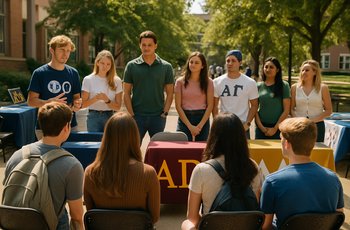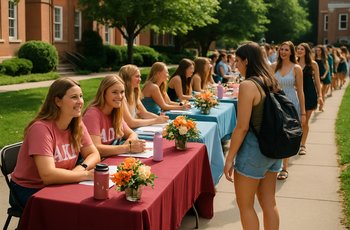
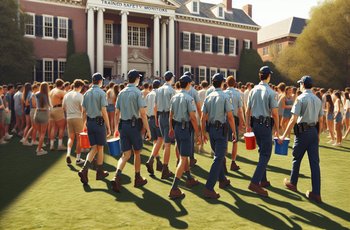
There's a new push at some California schools to require trained student monitors at Greek events - people who are sober, certified, and accountable for what happens during chapter functions. According to EdSource, these regulations are part of a broader effort to build safety into Greek life from the inside out, using students themselves as the enforcement mechanism rather than relying entirely on university administrators or chapter advisors hovering from a distance. On paper, it sounds reasonable. In practice, I have some thoughts.
Because I was in a sorority. I went through recruitment, held a position, planned events, and watched how safety protocols actually functioned in real time. And I can tell you that the gap between what's written in a policy and what happens on a Thursday night is enormous. Not because people are malicious - most of them aren't. But because culture is a stronger force than any training seminar.
The Monitor Role Is Harder Than It Looks
Here's the thing about assigning a student to monitor their own peers at a chapter event: you are asking them to do something genuinely uncomfortable. You're asking a sophomore to tell a senior to knock it off. You're asking someone who shares a house, shares rituals, shares inside jokes with these people to step in and enforce a rule. That's not a small ask. That's a social minefield.
I don't say this to dismiss the idea. Trained monitors can absolutely make a difference at the margins. But the EdSource piece gestures at something real without fully grappling with what makes it hard. Training someone on safety protocols is one thing. Giving them the actual social capital to act on that training is another problem entirely.
Chapters that already have strong cultures - where accountability is baked in, where older members model the right behavior, where people genuinely look out for each other - those chapters will use monitors well. Chapters where the culture is already broken? The monitor becomes a liability. They either get frozen out for being a buzzkill or they quietly stop doing the job because it's easier.
Why California Schools Are Worth Watching Here
California has been ahead of the curve on Greek life regulation for a while now. The state's legislative pressure on universities to take hazing and event safety seriously is real, and it's produced some structural changes that other states are still catching up to. So when EdSource covers this kind of regulatory push, it's not just a local story - it's a preview of where national Greek life policy might be heading.
And honestly, that's worth paying attention to. For every Penn State or Ohio State that ends up in the headlines after something goes wrong, there are dozens of schools quietly adjusting their oversight models and hoping the new rules stick. Trained monitor requirements fall into that category. They're not glamorous. They don't generate protest or outrage. They're just - procedural. Which is exactly why they can either work quietly in the background or fade into irrelevance without anyone noticing.
The optimistic read is that these kinds of requirements normalize the idea that chapter members have direct responsibility for each other's safety - not as a vague sisterhood or brotherhood principle, but as an assigned, trained, documented role. That normalization matters. When something becomes routine, it becomes part of the culture. Slowly.
What Nobody Talks About After the Training Ends
Here's what I actually want to know: what happens to the monitor after the event? Is there a debrief? Is there a place to report concerns without it blowing up into a full conduct investigation? Because one of the biggest gaps in Greek life safety systems isn't the rules themselves - it's the reporting infrastructure.
Students don't report things because they don't trust the process. They worry about retaliation within the chapter. They worry about the chapter getting suspended and everyone blaming them. They worry that making a formal complaint is the nuclear option when all they wanted was for someone to take a concern seriously. If trained monitors are gonna have any real impact, there needs to be a low-stakes pathway for them to actually use what they observed.
That part is harder to legislate. But it's the part that determines whether any of this works in practice.
Sororities like Zeta Tau Alpha and Alpha Chi Omega have invested real resources into member education and safety programming at the national level. Some of it is genuinely good. Some of it is liability management dressed up as values work - and members know the difference, even if they don't say it out loud. The trained monitor model has the same risk. It can be a real cultural intervention or it can be a checkbox that universities point to when something goes wrong.
Which one it becomes depends almost entirely on whether chapters treat it like the former and whether universities hold them accountable when they treat it like the latter. That accountability piece is where most of these initiatives quietly collapse. Not because the idea was bad. Because the follow-through was missing.
So yes - trained monitors are a start. A real one, not a fake one. But the story doesn't end when the certification is handed out. That's actually where it begins.