
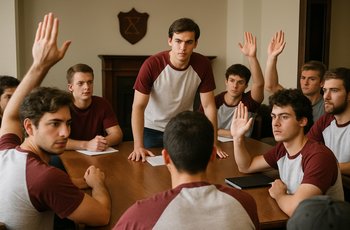
Every spring, fraternity chapters across the country go through the same ritual: a room full of guys vote on who gets to run things for the next year. From the outside, it looks like a straightforward democratic process. From the inside, it is often a months-long political campaign that would make a local city council race look tame.
I watched this happen up close more than I expected to, mostly through the guys in partner chapters and the ones I knew through friends of friends. And I'll be honest - what I saw was genuinely fascinating and occasionally a little alarming. Not because anyone was doing anything catastrophically wrong, but because the stakes felt so real to everyone involved, even when the actual power being contested was pretty limited.
The Campaign Nobody Admits Is Happening
Here's the thing about fraternity elections: they're almost never just elections. By the time voting night actually arrives, the result is usually half-decided already. Guys spend weeks building their case informally. Lunches, late-night conversations in the chapter house, carefully worded texts to brothers they're not that close to. It's retail politics. And nobody calls it campaigning because that would sound ridiculous, but that is exactly what it is.
The positions that generate the most heat aren't always the obvious ones. President, sure. But social chair, treasurer, recruitment chair - those offices have real day-to-day consequences for the chapter, and brothers know it. I talked to a guy from a Sigma Chi chapter who said the most brutal election he witnessed was for philanthropy chair because two brothers had completely different visions for what the chapter's community presence should look like. That surprised me. It probably shouldn't have.
What makes it complicated is the coalition math. Fraternities have pledge classes, and pledge classes tend to vote as loose blocs. Your class of 20 guys came in together, went through new member education together, formed bonds that didn't exist before. So when someone from your pledge class runs for a position, there's a pull - sometimes subtle, sometimes not - to back your own. A chapter with four active pledge classes is essentially working with four voting factions, and any serious candidate has to think about where his support is actually coming from.
When the Politics Get Genuinely Ugly
Most of the time, chapter elections are just kind of awkward and then it's over. Someone wins, someone is disappointed, life goes on. But sometimes it doesn't go that smoothly.
The worst situations tend to happen when the vote is close and the losing side doesn't really accept the result. Not formally - nobody is staging a coup - but informally, in how they cooperate with the new officer. A chapter president who won by a handful of votes against a popular opponent is going to spend months managing that residual friction. Brothers who backed the other guy aren't always subtle about their opinions. Meetings get tense. Decisions get second-guessed publicly in ways that undermine the whole operation.
And then there's the alumni factor. Some chapters have alumni who are quietly very involved in who runs the chapter. Not in a sinister way necessarily - they care about the organization, they have opinions, and they often have real relationships with active brothers through mentorship connections. But when a 45-year-old alumnus is calling guys on the phone before an election to advocate for a particular candidate, that's a different kind of pressure on a 20-year-old sophomore who's just trying to figure out how to vote. It muddies something that should be the chapter's own business.
I know a guy from a Sigma Alpha Epsilon chapter who ran for president his junior year and lost to someone he genuinely thought was less qualified. He told me later that the loss was one of the hardest things he dealt with in college - not because he needed the title, but because he'd put real thought into where the chapter needed to go, and watching someone else implement a different vision was genuinely painful. That's not immaturity. That's what happens when people actually care.
What Good Chapter Leadership Actually Requires
Here's where I'll say something that might be obvious but gets lost in the drama of the election itself: winning the vote is the easy part.
The brothers who actually move their chapters forward aren't necessarily the most charismatic guys or the ones who ran the savviest campaign. They're the ones who understand that they've been handed a short window - usually a year - to make decisions that will outlast them. Rush classes they recruit will be in the chapter long after they've graduated. Policies they set get baked into chapter culture in ways that are hard to undo. That's not nothing.
The best chapter presidents I've heard about from guys I know share a few things. They keep the losing candidates close rather than sidelining them. They're honest about what they don't know. They set expectations early rather than letting problems fester. And they understand that their job is mostly coordination and communication, not vision-casting from on high.
The worst ones tend to treat the office as validation rather than responsibility. They wanted to be president more than they wanted to do the job. That distinction matters enormously and it's visible pretty quickly once someone is actually in the role.
Honestly, the most useful thing a chapter could do is debrief properly after every election cycle - not just celebrate who won, but actually talk about how the process felt to the people in it. Were brothers informed? Did anyone feel pressured? Was the vote genuinely open? Most chapters don't do this. Which means they repeat the same dysfunction with slightly different faces each year.
Fraternity elections aren't broken because people are bad. They're messy because young men are being asked to practice democratic governance with real social consequences and almost no training. Some of them figure it out. Some chapters are still working through a bad election cycle from three years ago and don't even know it.