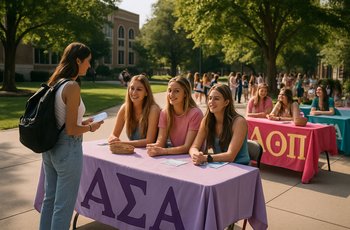

I didn't grow up wanting to be in a fraternity. Spent my freshman year doing my own thing, eating dining hall food with my floor mates, watching games on a 40-inch TV in someone's dorm room. That was fine. It was actually pretty good. But when I joined Sigma Alpha Epsilon my sophomore year, I found out fast that football season in a Greek house is a completely different category of experience - and not always in the ways I expected.
Some of it is genuinely great. Some of it will test your patience. Here's what nobody actually tells you going in.
The Logistics Are Real Work
Before I joined, I thought game day at a fraternity house was basically automatic. Like the whole thing just happened. Turns out there are guys whose entire week revolves around coordinating what time people are showing up, whether you're co-hosting with a sorority, who's in charge of the grill, where guests park, and about fifteen other things that never crossed my mind when I was just a random student showing up to stuff.
My chapter had a social chair who was basically project managing every home game weekend from Wednesday forward. And honestly, watching that unfold gave me a lot of respect for the work that goes into it. I used to just show up. Now I know what showing up actually costs.
The coordination with sororities is its own thing. If your chapter has a standing relationship with, say, Zeta Tau Alpha or Delta Delta Delta, there's usually some version of a shared plan for home games. That might mean splitting a tailgate space on the lot, or it might mean one house hosts pre-game and the other hosts after. Either way, someone has to actually organize it. And if that communication breaks down - which it sometimes does - you get two houses planning the same thing and stepping on each other.
I watched that happen once in my first season. It was a mess that was totally avoidable and it made the day awkward for everybody involved. Small thing, but it stuck with me.
The Social Pressure Is Quiet but Constant
Here's the thing about football Saturdays in a Greek house that took me a while to name: there's a kind of unspoken expectation that you're present. Not just physically. Actually engaged, showing up for the chapter, being visible with your brothers and their guests. That's not necessarily bad. But if you're someone who came from doing college independently - like I did - it can feel like a lot.
My freshman year, if I wanted to watch the game alone in my room, I did that. No one noticed. No one cared. In a Greek house, disappearing on a home game Saturday reads differently. It's not that anyone will explicitly call you out, but you will get asked where you were. And if it becomes a pattern, it becomes a chapter conversation.
I'm not saying that's wrong. There's something real about showing up for your community consistently - I actually believe that now. But if you're an introvert or someone who values low-pressure weekends, you need to know that Greek life during football season specifically will ask something of your social energy that the independent college experience doesn't.
Some guys love it. Some guys burn out by October. The ones who figure it out early are the ones who are honest with themselves about what they can actually sustain.
What Makes It Worth It
Look, I'm not gonna pretend the coordinated chaos doesn't produce something real. Because it does.
There's a specific kind of memory that comes from watching a big game with 60 people you actually know, in a space that belongs to your chapter, surrounded by people who are genuinely invested in the same outcome you are. I have a handful of those from my sophomore and junior years. I don't have anything close to that from my freshman year watching games in a dorm room.
It's kinda hard to explain to people who haven't experienced it. The best I can say is that it's the difference between attending something and belonging to something. Football season, more than any other part of the year, is when that distinction feels the most obvious.
Chapters like Sigma Chi or Kappa Sigma at schools with strong football programs - your Alabama, your Georgia, your Penn State - those houses can have a whole culture built around the season. Alumni come back. Traditions get passed down. There's institutional memory attached to specific games and specific years. I joined a chapter that had some version of that, and walking into it as a sophomore who had zero context for any of it was strange and then kind of incredible.
The Stuff That Will Actually Stress You Out
Away game weekends. That's the honest answer to what no one prepares you for.
Home games have structure. Everyone knows the plan, people know where to be, the house has a rhythm. Away games are a vacuum. Suddenly it's mid-October, there's no game at home, and the house either finds something to organize around or it just fragments. Some chapters handle this well. They plan brotherhood stuff, lean into the lower-pressure weekend, use the time for things that usually get crowded out. Other chapters just kind of drift and those weekends can feel flat in a way that's weirdly deflating.
I noticed this more than I thought I would. After a run of high-energy home Saturdays, an away game weekend where nothing is planned can feel like a small identity crisis for a chapter. That sounds dramatic but it's real.
The other thing - and this is minor but worth saying - is that your academic schedule does not care about game weekends. I had a chemistry exam the Monday after our homecoming game my junior year. I was not prepared for how hard it would be to carve out study time during that weekend. The chapter environment is not naturally quiet on home game Saturdays. That's not a criticism, it's just a fact. You have to plan ahead in a way that the independent college experience doesn't force on you quite as hard.
The guys who graduate on time from Greek houses have usually figured out that football season is when your time management either holds up or falls apart. It's not a mystery. It just requires more intention than it looks like from the outside.