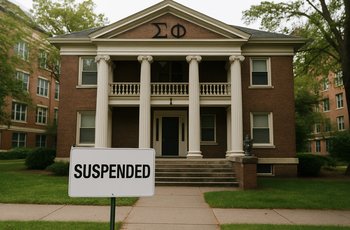

The Wall Street Journal ran a piece this week that a lot of people in Greek life governance have been quietly dreading. A rape case at Cornell. A university that had recently softened its stance toward fraternities. And a story that asks, out loud, whether colleges made a mistake by pulling back from the harder line on Greek organizations. If you've sat on a Panhellenic council or watched an IFC try to self-govern, you already know where this is headed.
I'm not going to pretend I have all the details of the Cornell case - I don't, and the WSJ piece itself is careful about what it confirms. But the broader frame of the article is something I've watched play out at multiple institutions. University relationships with Greek chapters go in cycles. There's a scandal, a crackdown, a suspension wave. Then five or six years pass, enrollment pressure builds, alumni donors make noise, and suddenly the administration is quietly walking back its toughest policies. Chapters get reinstated. Oversight gets lighter. And then something happens again.
The Embrace Was Always Conditional
What frustrates me about how this story is being framed in mainstream coverage is the implication that universities getting friendlier with fraternities was some kind of ideological shift. It wasn't. It was a financial and enrollment calculation. Greek life drives housing revenue, alumni giving, and retention numbers that administrators care about deeply. When a school says it's embracing fraternities, what it usually means is that the calculus changed - not the values.
I've been in the room when chapter standing gets reviewed. I've seen chapters come off probation not because they genuinely fixed anything, but because the paperwork cleared and nobody wanted to keep having the conversation. That's not a Cornell-specific problem. That's a structural problem with how Greek governance works at almost every school that has it.
The NPC and NIC both publish member organization standards. Every national organization has a risk management policy. Sigma Chi, Kappa Sigma, Sigma Alpha Epsilon - they all have them. And those policies exist on paper in a way that looks serious until you watch a local chapter treat them like a terms-of-service agreement they clicked through without reading. Enforcement only happens when something surfaces publicly. That's the honest truth of it.
Self-Governance Has Real Limits
Here's the thing that gets lost whenever one of these stories breaks: Greek organizations are being asked to self-govern behaviors that other campus organizations don't even have to think about, partly because those other organizations don't control housing, don't run social events at the same scale, and don't have the same power dynamics baked into their membership model.
Panhellenic councils can write recruitment rules all day long. We can run values-based recruitment workshops. We can update the COB policy and train chapter presidents on Title IX obligations. And all of that matters - I believe that genuinely, or I wouldn't have spent the time I did on council. But Panhellenic governs sororities. What happens inside an IFC chapter house is a different jurisdiction, and the coordination between those two governance structures is often worse than people realize.
At most schools, IFC and Panhellenic operate like parallel governments that occasionally share a conference room. There's no unified enforcement. There's no shared incident tracking that actually functions. And the university sits above both of them with authority it only exercises selectively.
So when the WSJ frames this as colleges embracing fraternities backfiring - yeah, I think that's directionally right. But it's not because the embrace was the problem. It's because the embrace came without the structural accountability that would have made it defensible.
What the Coverage Gets Wrong
Stories like this tend to produce one of two reactions in Greek life circles. Half the people say see, this is why we need to abolish the whole system. The other half go defensive and start talking about philanthropy hours and GPA averages. Both of those responses are a way of avoiding the actual question, which is: what does real accountability look like, and who is responsible for building it?
Honestly, I think the people most responsible for answering that are the ones inside the system. Not the WSJ. Not the university PR office scrambling to respond. The Panhellenic exec boards, the IFC presidents, the Greek advisors who actually know what's happening in individual chapters. The ones who've seen a chapter's behavior in real time and had to decide whether to escalate it or manage it quietly.
That decision - escalate or manage quietly - is where everything either holds or falls apart. And right now, the incentives push hard toward managing quietly. Because escalating means bad press, means a chapter's members get hurt by something they might not have personally done, means your council looks like it can't handle its own community. The system rewards silence in ways that are genuinely difficult to fight from inside it.
Cornell will handle this the way schools handle these things. There will be a review. There will be statements. Some policy will get updated in language that sounds significant. And at every other school with a Greek community, administrators will read the coverage and do a quiet internal check on their own exposure - not their own accountability. Their exposure.
That distinction is the whole problem. And no amount of embracing fraternities or cracking down on them is gonna change it until that changes first.