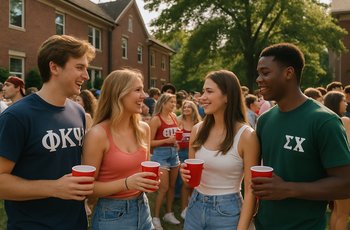

Every fraternity has a social calendar that looks impressive on paper. Mixers, formals, date nights, tailgates - the whole lineup. And yeah, those events are fun. Nobody's pretending they're not. But ask any guy five years out of school what he actually remembers about his chapter, and I promise you it's not the mixer with Kappa Kappa Gamma from junior year. It's the camping trip where someone's tent collapsed at 2am. The road trip to a brother's hometown. The random Tuesday night when half the chapter ended up in someone's basement talking until 4am about nothing and everything. Brotherhood events - the unglamorous, low-stakes, not-on-the-recruitment-flyer kind - are where actual bonds get made.
I'm coming at this from the sorority side, so take that for what it's worth. But I watched this dynamic play out in real time, both in my own chapter and in the fraternities we interacted with. The chapters that had genuinely close brothers were always the ones doing stuff together that wasn't about impressing anyone. The chapters that seemed close on Instagram but fell apart at the first sign of internal conflict? Heavy social calendar, light on the brotherhood programming.
Socials Are Performative By Design
This isn't a knock on socials. They serve a purpose - they're how you meet people outside your chapter, how you build cross-Greek relationships, how you actually participate in the broader Greek community on campus. But they're also inherently performative. You're presenting a version of yourself. You're thinking about how your chapter looks. You're on. There's nothing wrong with that, but you're not building deep trust in that environment. You're building a reputation. Those are completely different things.
Brotherhood events strip all of that away. A chapter retreat where you're stuck in a cabin with no cell service for a weekend doesn't care how cool you seem. A service project at 7am on a Saturday definitely doesn't. Neither does a chapter flag football league or a camping trip where someone inevitably forgets the food and you're all problem-solving together at 9pm in the middle of nowhere. Those situations reveal who people actually are. And that's the whole point.
Sigma Chi chapters that stay tight decades after graduation aren't tight because they all went to the same formals. Sigma Alpha Epsilon alumni networks that actually function - the ones where a brother from a different era will genuinely go to bat for you professionally - those exist because there was real substance underneath the social calendar. Substance built in the spaces that weren't about looking good.
What Brotherhood Events Actually Do That Nothing Else Can
There's a specific kind of trust that only gets built through shared low-stakes weirdness. That sounds vague, so let me be more specific. When you and your brothers spend a weekend doing something completely unrelated to Greek life - hiking, volunteering, going to a minor league baseball game, whatever - you learn things about each other that a mixer will never teach you. You learn who's actually funny. Who gets quiet under stress. Who steps up when something goes sideways. Who you'd actually call if something went wrong at 11pm on a Wednesday.
That information matters. It's the difference between a brother you'd call and a brother you'd text happy birthday to once a year. And honestly, the ratio of those two categories in your chapter is basically a direct measure of how much brotherhood programming your chapter actually prioritizes.
Fraternities that run strong brotherhood programming tend to have better retention too. This isn't a coincidence. Guys don't stick around for four years in something that's just a social calendar - they can get that without paying dues. They stick around because they have real relationships. Because the chapter feels like something worth staying in. Kappa Sigma chapters that invest in internal events consistently see tighter classes, better communication during elections, and brothers who actually show up for mandatory stuff instead of ghosts who surface twice a semester.
The Difference Between a Chapter That Lasts and One That Doesn't
I've seen chapters implode from the inside - internal conflicts that should have been manageable turning into full splits, officer elections getting ugly, brothers who stopped talking entirely by senior year. And in almost every case, when you traced it back, the common thread was a chapter that was all performance and no real relationship underneath it. When you don't actually know someone - like really know them - you have no goodwill to draw on when things get hard. And things always get hard eventually.
The chapters that weather conflict well are the ones where brothers have enough shared history to give each other the benefit of the doubt. Where disagreements don't immediately become personal because there's actual trust in the room. You build that trust on camping trips and philanthropy days and chapter retreats, not at mixers with Alpha Chi Omega.
Look, I'm not saying socials are worthless. I'm saying they're being prioritized at the expense of the stuff that actually makes a chapter cohesive. If your brotherhood event budget is a fraction of your social budget - if brotherhood events get canceled when something else comes up but socials never do - that's a choice your chapter is making. And it's gonna show. Maybe not in recruitment numbers. But in everything that matters after recruitment.
The fraternity experience you'll talk about at 35 isn't the formal. It's the random Wednesday in November when nothing was planned and somehow it became one of the best nights of your college life. Those nights don't happen on a social calendar. They happen because your chapter actually built something real underneath the events that were supposed to matter.