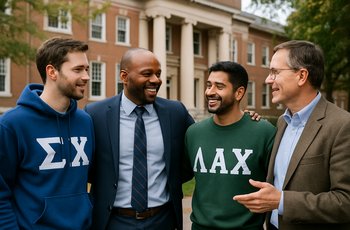

Every chapter has that one position that nobody really campaigns for during elections. The social chair gets the hype. The president gets the respect. The treasurer gets the headaches. But the academic chair? He's just the guy who sends reminder emails before midterms and maybe puts a sign-up sheet on the whiteboard for study hours. That's the reputation, anyway. And it's completely wrong.
I didn't understand what the academic chair actually did until my junior year, when a brother named Marcus took the role and basically rebuilt how our chapter thought about grades from the ground up. Before that, academics were something we dealt with reactively - someone fell below the GPA threshold, we panicked, we figured it out. Marcus changed the whole posture. And watching that transformation is what made me realize this position is probably the most underrated role in any chapter, IFC or otherwise.
It's Not About Study Hours
Here's the thing - study hours exist at basically every chapter. You log your time, you hit your minimum, you move on. That's not academics, that's compliance. The academic chair who actually does the job understands that distinction. He's not trying to make brothers sit in the library for a certain number of hours each week. He's trying to build something that actually functions when a brother is drowning in organic chemistry at 11pm on a Wednesday.
The good ones build a real internal network. They know which brothers are pre-med and which ones have already taken the courses that the new members are struggling through right now. They maintain - informally, sometimes just in their own head - a running map of academic resources inside the chapter itself. That's valuable. That's an asset that most chapters have and never actually use.
I've seen academic chairs at chapters like Sigma Alpha Epsilon and Kappa Sigma do this exceptionally well. Not because those organizations are inherently more serious about grades, but because someone in that role decided to treat it like it mattered. The ones who treat it like a checkbox produce chapters that treat academics like a checkbox. The ones who take ownership produce something different.
The Alumni Connection Nobody Talks About
This is the part that I genuinely think gets overlooked everywhere. The academic chair sits on one of the most powerful bridges between active members and alumni - and almost nobody builds it out properly.
Think about what alumni actually want to give back. Most of them aren't gonna show up to help with recruitment or coach you on philanthropy events. But a lot of them will absolutely take a phone call from an active brother who's trying to figure out a career path, or struggling with whether to pursue graduate school, or just wants to know what it was actually like to work in a specific industry. That's a natural conversation. That's not awkward at all.
The academic chair is the right person to own that pipeline. Build the relationship with alumni who are five, ten, fifteen years out. Create the connection between a sophomore who's lost about his major and a brother from 2009 who went through the exact same thing. That's not a tutoring program. That's mentorship built into the structure of the chapter. And it lasts.
Some of the most meaningful conversations I had in college came through those kinds of connections - an older alum who came back for Founders Day, ended up talking to me for an hour about the career path I was panicking about. That didn't happen by accident. Someone made sure he was in the room and made sure I knew who he was. That's the academic chair's job too, even if nobody writes it into the position description.
What a Chapter's GPA Actually Says
Honestly, chapter GPA gets treated as an embarrassment metric. You look it up when you're trying to figure out if you're above the all-men's average, you feel good or bad about it, and you move on. That's a shallow way to look at it.
Chapter GPA over time tells you something real about the culture. A chapter that consistently sits near the top of IFC isn't doing it because they're admitting smarter members. They're doing it because academic achievement is genuinely valued inside the organization - not just tolerated. Brothers who care about their grades don't hide that. They talk about it. They help each other. They create an environment where admitting you're struggling isn't embarrassing.
That culture doesn't build itself. Someone has to make it normal. The academic chair is in the best position to do that - not through policy, but through behavior. How he talks about grades in chapter meeting, whether he publicly recognizes brothers who pull their GPA up after a rough semester, whether he creates space for honest conversations about academic pressure. Those small things compound over years.
A chapter that treats academics as an afterthought is going to fight that reputation for a long time. Administrations notice. Potential members notice. The chapters that figured this out - and there are plenty of them across every school - did it because someone decided the academic chair role was worth doing seriously.
Marcus graduated before I did, and the brothers who came in after him inherited a chapter that actually talked about grades without it being weird. Study tables had real attendance because people wanted to be there, not because they were required. The resource map he built - who had taken what, who was good at what - lived on past him because brothers kept adding to it. That's a tradition. It just doesn't look like one from the outside.
Next time your chapter holds elections and the academic chair position comes up, pay attention to who wants it and why. It says more about your chapter than almost any other vote you'll take.