
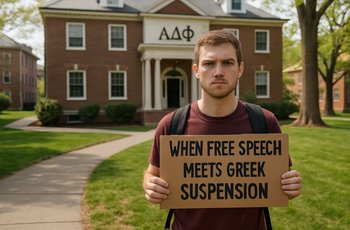
Lafayette College just handed a national free speech organization enough material to ask some serious questions, and honestly, I don't think Greek life is ready for the conversation that follows. The Foundation for Individual Rights and Expression raised concerns about Lafayette's decision to suspend Greek life activities across the board - and from where I've sat on a Panhellenic council, I can tell you that broad suspensions like this one don't just raise free speech flags. They expose every flaw in how universities think they can govern Greek organizations.
I want to be clear about what I'm reacting to here. This wasn't a targeted suspension of one chapter with documented violations. This was a sweeping pause on Greek life activity at the institutional level. And when a national organization focused on campus rights starts asking questions about a university's Greek life decision, that's not just noise. That's a signal that the administration may have skipped some steps.
Blanket Suspensions Are a Governance Failure
Here's the thing about broad suspensions - they almost never hold up to scrutiny when you pull them apart. I've watched councils deal with fallout from incidents where one chapter did something wrong and the entire Greek community got penalized for it. And every single time, the chapters that had clean records, documented programming, up-to-date compliance filings, and zero incidents were furious. Rightfully so.
When I was involved in Panhellenic, we had a standards process. Chapters could be placed on social probation. New member intake could be suspended for a specific organization if they were under investigation. There were escalating steps built into the structure precisely because you don't torch the whole system to address the behavior of part of it. That's not governance. That's panic dressed up as policy.
Lafayette's administration may have had reasons for going wide rather than narrow. I don't have the full internal picture. But the fact that a free speech group is now publicly asking questions suggests the rationale wasn't communicated clearly - or wasn't legally airtight - or both. And from a governance standpoint, that's a problem that starts before the suspension is ever announced.
The Process Question Nobody Wants to Answer
What I keep coming back to is the process. What actually triggered this? Was there a specific incident? An ongoing pattern? Did individual chapters receive written notice with specific allegations before the suspension took effect? Were there any hearings? Any opportunity to respond?
These aren't just procedural niceties. They matter because Greek chapters - whether they're affiliated with the National Panhellenic Conference, the North-American Interfraternity Conference, or any other governing body - have their own organizational structures, member rights, and in some cases, property and contractual interests. You can't just shut all of that down with a blanket email and expect no one to push back.
The Foundation for Individual Rights and Expression getting involved means someone pushed back. And honestly, given what broad institutional suspensions can look like from the inside, I'm not surprised.
Look, I'm not reflexively anti-administration here. I've seen chapters that absolutely needed to be suspended. I've sat in rooms where we had to make hard calls about which organizations were not meeting minimum standards for membership education or financial accountability. Sometimes suspension is the right call. But the decision to suspend one chapter for cause is completely different from suspending an entire Greek community - and the latter requires a much higher standard of documented justification.
Small Schools Carry This Differently
Lafayette is not a big state school with dozens of chapters absorbing the blow independently. It's a smaller college where Greek life carries a different kind of weight in the campus social and organizational fabric. At schools like that, a blanket suspension doesn't just affect party schedules. It affects philanthropy events. It affects chapter-run tutoring programs. It affects alumni programming and chapter finances and member housing situations in some cases.
I've said before that small school Greek life operates on a completely different scale than what you'd see at a University of Alabama or Ohio State. When something goes wrong at a big school, the system has enough mass that individual chapters can weather it. At a smaller institution, a community-wide suspension hits every chapter at the same time with the same force - and the chapters that were doing everything right have no buffer.
That asymmetry matters when you're evaluating whether a suspension was proportionate. If the documented concern was about specific chapters or specific conduct, then the suspension should have been specific. Reaching beyond that is where free speech groups and legal challenges tend to find their footing.
What Actually Gets Decided in Rooms Like This
I've been in those administrative-council meetings where suspensions are discussed. And what strikes me every time is how quickly the conversation jumps to the outcome without working through the framework. Someone wants action. Someone else wants cover. And the thing that gets lost is the question of whether the action being proposed actually fits what the policy allows.
Panhellenic and IFC councils have governing documents. Those documents don't just exist for show. They define what council can do, what the university can do, and where those authorities intersect. When an administration acts outside that framework - even with good intentions - they create the exact kind of ambiguity that invites outside scrutiny.
The Lafayette situation is still developing and I'm not gonna pretend I have all the facts. But the moment a free speech organization steps in with formal questions, the burden shifts. The university now has to show its work. And if the work wasn't done carefully the first time, this is gonna be a long and messy process for everyone involved - including the chapters that had nothing to do with whatever triggered this in the first place.
That's the part that frustrates me most. Not the scrutiny itself - scrutiny is fine, scrutiny is how bad decisions get corrected. It's that the chapters caught in the middle of a poorly structured suspension didn't make the decision that created this situation. They're just living in the fallout.