
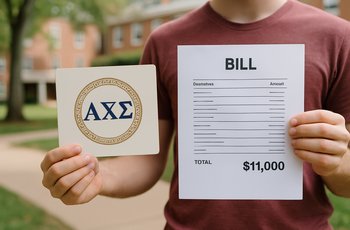
Recruitment chairs are great at a lot of things. Giving you a realistic budget breakdown before you sign your bid card is not one of them. I found out what my fraternity actually cost me around three weeks into pledging, when I opened my member portal for the first time and sat with my jaw on the floor staring at a number I had not mentally prepared for. Nobody lied to me exactly. They just... didn't volunteer the full picture.
So here it is. The full picture. The one I wish someone had handed me over coffee before I committed to anything.
The Number They Quote Is Not the Number
Every chapter has a dues figure they lead with during recruitment. It sounds reasonable enough. Maybe it's $400 a semester, maybe it's $700. You nod, you do the mental math, you decide it's manageable. And then you actually join and discover that number was basically the cover charge. The real bill has several more line items.
National dues exist on top of chapter dues. Always. Organizations like Sigma Alpha Epsilon, Kappa Sigma, and Sigma Chi all have national headquarters that collect their own fees, and those fees go toward insurance, programming, your national alumni network, and a bunch of other stuff that matters in theory but feels abstract when you're a 19-year-old trying to figure out how to afford it all. Depending on the org, national dues can run anywhere from $100 to $300 per semester on their own.
Then there's the new member fee. One-time, paid during pledging, and often not mentioned until after bid day. Think of it as an initiation surcharge. Some chapters roll it into your first semester bill quietly. Others hand you a separate invoice. Either way, it exists and it's real money - sometimes as high as $500 depending on the chapter and school.
Add chapter housing fees if you live in the house. Add meal plan costs if the house has a cook. Add the social fee that funds events. Add the philanthropy fee. Add officer assessment fees if you ever take a leadership role. It adds up fast, and the total annual cost for a typical fraternity member at a mid-size school is somewhere between $2,000 and $5,000 per year when you count everything. Some chapters at bigger schools run higher than that.
The Informal Costs Are Where It Gets Wild
Here's the thing nobody even bothers to put on an invoice because it's technically optional - except it's really not. I'm talking about all the stuff that comes with actually participating in chapter life.
Formal is the big one. Every chapter throws a formal. You're buying tickets for yourself and a date, covering a hotel if it's out of town, getting a dress shirt or a suit if you don't own one, and probably chipping in for a group dinner beforehand. A single formal weekend can run $200 to $400 out of pocket depending on location.
Brotherhood retreats. Philanthropy events where you're expected to donate or buy a T-shirt. Bid day outfits. Composite photos - yes, those cost money and yes, you typically pay for your own spot. Alumni weekends. Homecoming floats. Greek Week entry fees. None of these are in the number they quote you at recruitment.
I had a brother in my chapter who pledged thinking he was signing up for $800 a year. By the end of his first semester he had spent closer to $1,800 when everything was added up. He wasn't bad at math. He just had incomplete information going in.
Sorority Costs Are a Whole Other Conversation
I can't speak from personal experience here, but the women I knew going through Panhellenic recruitment at my school - chapters like Delta Delta Delta, Kappa Kappa Gamma, Alpha Chi Omega, Zeta Tau Alpha - were dealing with cost structures that often ran even higher than what fraternities charge. Sorority houses at bigger schools are frequently nicer and more expensive to maintain, which flows downhill to member dues. Chapter apparel expectations tend to be more intensive. Recruitment itself involves more rounds, more outfits, and more logistical overhead.
A sorority member I knew at a large SEC school was paying close to $3,000 a semester when housing, dues, and incidentals were all combined. That's not extreme for her context. That's just what it cost to be a full, active member in good standing.
None of this means Greek life isn't worth it. I'm not here to talk anyone out of anything. But the financial ask is significant and the gap between the recruitment pitch and the actual invoice is real enough that people should go in with eyes open.
What You Should Actually Ask Before You Sign
Before you accept a bid - or before your kid accepts one - here are the actual questions worth asking:
- What are chapter dues, national dues, and new member fees combined for the first semester?
- Are there housing fees or required meal plans if I live in the house? What about if I don't?
- What does the social fee cover and how much is it per semester?
- Are there any fees tied to initiation, composite photos, or required chapter events?
- What did an average active member spend last year - total, including informal costs?
That last question is the one they'll dodge the most. Push for it anyway. A chapter with nothing to hide will give you a straight answer or connect you with a current member who will. A chapter that gets vague or changes the subject is telling you something whether they mean to or not.
Honestly, most recruitment chairs aren't trying to deceive anyone. They just genuinely don't think about cost from the outside perspective because they've been inside the chapter long enough to normalize it. They stopped noticing the price tag the way you stop noticing your rent after the first few months. That doesn't make the number smaller. It just means the burden of asking the right questions falls on you.