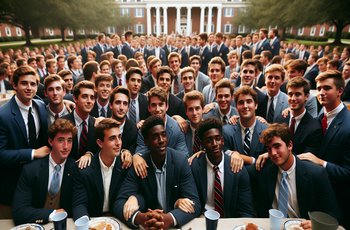

When I joined my fraternity back in 2020, one of the older brothers pulled me aside during pledging and said something I've thought about a lot since: "The chapter you're joining isn't the chapter on Instagram." He meant it as a warning. It took me four years to fully understand what he was actually describing.
Social media and Greek life have wrapped around each other so tightly at this point that you honestly can't talk about one without the other. And I don't think that's entirely bad - but I also don't think it's entirely good. What it is, mostly, is complicated in ways that nobody really talks about honestly.
The Recruiting Machine Nobody Planned For
Here's the thing about rush content. Nobody sat down in some boardroom and decided that sorority recruitment videos were going to become a cultural phenomenon. It just happened. And now chapters at Alabama or Ole Miss have girls going viral with multi-day outfit sequences and cinematically edited bid day videos, and suddenly every other chapter in the country is measuring itself against that.
I watched this happen in real time with the guys around me. Somebody would see a Sigma Chi chapter at some SEC school post this incredible philanthropy event recap - drone footage, slow motion, the whole thing - and suddenly our social chair was under pressure to match that energy with a budget that was definitely not drone footage money. It created this arms race of presentation that had very little to do with what actually made the chapter worth joining.
The flip side is real though. For recruits who are genuinely nervous about Greek life, being able to watch real chapter culture play out on TikTok or Instagram before ever stepping foot on campus - that matters. I had a buddy transfer in junior year who said he already knew which fraternity he wanted to rush based on how they carried themselves online. He wasn't wrong about them either. So it works, sometimes.
Brotherhood Doesn't Really Post Well
This is the part that actually bugs me. The stuff that made my fraternity worth four years of my life is almost completely invisible on social media. It's not the philanthropy graphic or the formal photos or the recruitment reel. It's the random Tuesday night where six of us stayed up until 2 a.m. helping a brother work through a genuinely rough situation. It's the guys who drove three hours to show up at a funeral for a brother's dad. It's the dumb inside jokes that accumulated over years until they became their own language.
None of that posts well. And because it doesn't post well, it doesn't get posted. So what people see from the outside is the curated version - the matching formals, the sponsored philanthropy runs, the recruitment videos with copyright-free hype music. Which, again, isn't fake exactly. But it's about fifteen percent of the actual story.
Honestly, I think this is why recruitment conversations can feel so shallow sometimes. Both sides are performing. The active brothers are performing the chapter they want to look like. The recruits are performing the version of themselves they think the chapter wants. And somewhere in that exchange, the actual question - would these people genuinely show up for each other - gets lost under a pile of content strategy.
Accountability Has a New Address
Okay, here's where I'll say something that might surprise you coming from a fraternity guy: social media has genuinely made some chapters behave better, and I think that's a net positive.
When I was a sophomore, a chapter at another school near us had something go badly wrong at an event. Within about six hours it was everywhere - Reddit, Twitter, local news had picked it up from student posts. The national organization had issued a statement by morning. That kind of speed would have been impossible ten years ago. Would have been a quiet internal thing that maybe got addressed, maybe didn't.
Now, I'm not saying social media accountability is perfect - it absolutely isn't. It moves fast and it often doesn't care much about nuance or due process, and I've seen chapters get dragged publicly for things that turned out to be way more complicated than the initial post suggested. That's a real problem. But the baseline awareness that someone might document something and that documentation might travel fast - that has changed the calculus for a lot of chapters in ways that probably needed changing.
Zeta Tau Alpha, Kappa Kappa Gamma, Alpha Chi Omega - chapters with real institutional pride don't want to be the one going viral for the wrong reasons. That's not nothing. Sometimes the fear of a bad screenshot is doing governance work that the actual governance structure wasn't doing.
The Version of Yourself You Post
The part nobody really prepares underclassmen for is what happens to your own identity when Greek life meets the constant pressure to document everything. I noticed it in myself junior year. I'd be at a brotherhood event, actually having a good time, and there'd be this little voice suggesting I should capture this. Not to remember it - I have a memory for that. But to post it. To show something.
That's a weird headspace to be in. And it doesn't stay contained to social media. It starts to shape what events feel worth doing, which moments feel worth having, based on their postability. That's a genuinely strange thing to do to real human experience.
Some chapters have started doing phone-free events - not as a rule exactly, but as a vibe - and my honest opinion is that those tend to be the ones people talk about afterward. Sigma Alpha Epsilon chapters I've seen doing this, some Pi Beta Phi chapters doing the same thing with sisterhood events. The idea being that maybe some things are just for the people in the room.
That old brother who warned me during pledging was more right than he knew. The chapter on Instagram is a real thing. It just isn't the whole thing. And the gap between those two versions is basically where all the interesting questions about Greek life actually live.