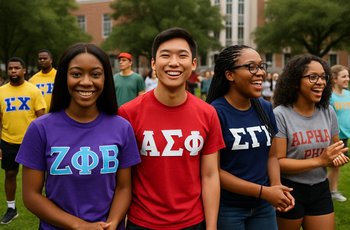

There's a woman named Trisha Addicks who has apparently made a very good living telling sorority hopefuls exactly how to present themselves during recruitment. The Times recently ran a piece on her, calling her America's most sought-after sorority rush coach. She advises PNMs on what to wear, what to say, how to carry themselves, how to seem like exactly the kind of person a chapter wants to invite in. And from a pure business standpoint? Good for her. She found a market and she's working it. But from where I'm standing - as someone who went through IFC recruitment and came out the other side actually believing in what Greek life can be - this whole industry makes me uncomfortable in a way I can't fully shake.
Not because coaching is inherently wrong. And not because I think PNMs shouldn't prepare. But because what Addicks is selling, when you strip it back, is the ability to pass as someone you're not. Or at the very least, the ability to perform a version of yourself that's been optimized for a room full of strangers in matching outfits who have about seven minutes to decide if they like you.
Recruitment Was Always a Performance. That's the Problem.
Here's the thing - I get why this industry exists. Sorority recruitment at big schools is genuinely intense. We're talking about girls showing up to multi-round processes at schools like Alabama or Ole Miss where the stakes feel impossibly high, where the social consequences of not getting a bid from the right house feel real and lasting. At that level of pressure, of course people are gonna hire coaches. They hire SAT tutors. They hire college application consultants. This is the same instinct.
But there's something different happening here. A test score is yours once you earn it. What Addicks is coaching - the way you present your personality, the stories you tell, the way you laugh at the right moment - that's not a skill you're developing. That's a mask you're renting for rush week. And eventually, the chapter you join is going to meet the real you. What happens then?
I watched a guy go through IFC recruitment at my school who had clearly done some version of this - not with a formal coach, but with older brothers from a different chapter who prepped him on talking points. He was polished. He hit every house with the same three stories, the same energy, the same handshake. He got a bid from a top house. And by second semester of his pledge semester, he was miserable. The version of himself he'd sold didn't actually fit inside the chapter he'd worked so hard to get into. He ended up depurating himself. Nobody talks about that part.
What This Says About Recruitment Culture
The existence of a booming rush coaching industry tells you something pretty direct about how recruitment actually works right now. It's not selecting for authenticity. It's selecting for performance ability. And that's a structural problem that no amount of coaching - or anti-coaching - is going to fix on its own.
Chapters bear some of this responsibility too. When you run a recruitment process that's so compressed, so surface-level, so dependent on first impressions and aesthetic fit, you're basically inviting this. You create the conditions where a trained PNM beats an unprepared one every single time, regardless of who would actually be a better member. Pi Beta Phi chapters, Kappa Kappa Gamma chapters, Zeta Tau Alpha chapters - they all say they're recruiting for character and values fit. But if a recruitment process doesn't give you enough time to actually see character, you're just recruiting for whoever presents best under pressure. And Trisha Addicks has figured out how to manufacture that.
Honestly, this bothers me more on the sorority side than the fraternity side - partly because IFC recruitment tends to be less formalized, but mostly because the pressure women face going into Panhellenic recruitment is on a completely different level. The coaching industry exists almost entirely in that space. There are no Trisha Addickses coaching guys through Sigma Chi or Kappa Sigma rush. We go, we hang out, we see who fits. It's imperfect, but it at least leaves room for something real to come through.
The Brotherhood Question Nobody Asks the Coaches
What actually made Greek life meaningful to me had nothing to do with how I performed during recruitment. It was the stuff that came after. First formal retreat. The night one of my brothers got some really bad news from home and about twelve of us just stayed up with him in the chapter room until 3am talking about nothing and everything. Initiation - the actual ceremony, the words that have been passed down since the founding of our chapter, the moment it stops feeling like a club and starts feeling like something you belong to.
You can't coach your way into that. And here's what worries me most about the rush coaching trend - it selects for people who are optimized for the door, not for what's behind it. The best members I've known in any house were the ones who came in a little rough around the edges, who weren't the obvious pick, but who turned out to have exactly the right values once you got past the surface stuff. A polished presentation would have made them look like everyone else. Their realness is what made them stand out to the people paying attention.
Rush coaches like Addicks aren't going anywhere. The market is clearly there and clearly growing. But I'd push back hard on any chapter - fraternity or sorority - that looks at a coached PNM and sees a well-prepared candidate. What you're seeing is someone who learned how to look prepared. Those are very different things. And your recruitment process should probably be designed to tell the difference.