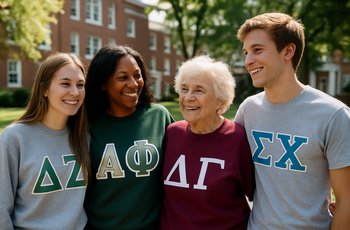

There's a piece running in The State Press right now asking whether sorority recruitment has turned into a search for fame rather than a search for sisterhood. And honestly, I've been thinking about that question all week - not from the Panhellenic side, but from where I sit as someone who went through IFC recruitment and watched dozens of women go through theirs at the same time. The question itself tells you something about where Greek life is right now.
Because here's the thing - recruitment was never simple. It was always performative to some degree. You put on your best clothes, you shake hands with strangers, you talk about your high school leadership positions like they define you. That's been true since before any of us were born. But what The State Press is pointing at feels different. It's the TikTok-ification of the whole process. Chapters trending. Girls going viral for getting their top-choice bid. The actual experience of joining a sisterhood getting flattened into content.
What Recruitment Actually Used to Signal
I'm not gonna pretend I have deep insider knowledge of how Panhellenic recruitment runs. But I know what rush meant on my side of the street, and I watched my sister go through formal sorority recruitment at a Big Ten school a few years back. What I saw from her - and what I remember from my own process - was that the best moments were never the ones that looked good from the outside.
My pledge semester, there was a night where about fifteen of us just sat in the chapter room until 2 AM talking about why we actually joined. No ritual, no ceremony - just brothers being honest with each other. That kind of thing doesn't film well. It doesn't get three hundred thousand views. But it's the reason I still answer the phone when a brother calls.
My sister said something similar. The moment she knew she'd made the right choice wasn't bid day - it was two weeks later when an older member she barely knew showed up to help her through a rough week academically. That's what sisterhood actually looks like. And you can't recruit for that on social media.
The Fame Problem Is Real, But It's Not the Chapter's Fault
Here's where I'll probably lose some people. I don't think the chapters themselves are the problem. Chapters like Kappa Delta, Zeta Tau Alpha, Alpha Chi Omega - these organizations have real histories, real rituals, real alumnae networks that have been running for over a century in some cases. The sisterhood isn't fake just because the recruitment video got shared fifty thousand times.
The problem is the filter the platform puts on it. When a potential new member is evaluating chapters based on their Instagram aesthetic or how many followers their members have, she's not evaluating the actual organization. She's evaluating its marketing. And those two things have almost nothing to do with each other.
I've seen fraternity recruitment fall into the same trap. Chapters that are genuinely strong - good brotherhood, solid alumni engagement, actual academic culture - can lose recruits to chapters that just look better on a highlights reel. That's not a Greek life problem. That's a social media problem that has infected Greek life because recruitment happens to be visual and public in a way that a lot of college experiences aren't.
What Gets Lost When Image Wins
What actually matters in a sorority - or a fraternity - is almost impossible to evaluate from the outside during a recruitment event. You can't see the chapter's internal culture in a Canva-designed bid day graphic. You can't tell whether members actually support each other through hard semesters by watching a choreographed reveal video.
The State Press piece is raising a legitimate concern. If the women going through recruitment are choosing chapters based on perceived status or social media clout rather than genuine fit, then the whole point of the process breaks down. You end up with members who feel disconnected from their chapter - who joined the idea of a sorority instead of an actual one. And chapters full of people who joined for the wrong reasons don't stay healthy for long.
I've seen that play out in fraternities. Pledge classes that came in because the chapter had a reputation, not because they actually clicked with the brothers. Those classes almost always had higher dropout rates, more internal conflict, and less engagement with actual chapter traditions. You can coast on reputation for a semester. You can't build something real on it.
The Traditions Are the Point
What I keep coming back to - and what I think The State Press piece is really getting at beneath the surface - is that Greek organizations are built around specific rituals and traditions for a reason. Those traditions aren't window dressing. They're the mechanism through which the organization actually transmits its values from one generation of members to the next.
When recruitment becomes primarily about image and visibility, those traditions get deemphasized. They don't photograph well. They're internal. They're sometimes weird, or solemn, or require context to understand. And so they get replaced - not officially, but effectively - by the stuff that does film well. The matching outfits. The countdown reveals. The bid day screaming.
None of that is inherently bad. But it should be the surface, not the substance. And when recruits are choosing chapters based entirely on the surface, the chapters that invest most in their actual culture start losing to the ones that invest most in their appearance.
My honest read: the chapters that will survive this moment with their culture intact are the ones that trust their traditions enough not to perform them. That recruit women who are genuinely looking for something real, even if that's a smaller pool. Kappa Kappa Gamma didn't last this long by going viral. Pi Beta Phi didn't build a national network by having the best aesthetic. Those organizations built something durable because their members believed in what they were part of - and that started with bringing in the right people, not the most visible ones.
The fame question The State Press is asking matters. I just don't think fame is what most of the women going through recruitment actually want - even if that's what the process is starting to reward.