Every chapter has that one mixer theme they'll talk about for years. The one where everything clicked - the costumes were creative, the energy was there, and nobody ended up on a ladder trying to fix something at the last minute. And then every chapter also has the theme that someone pitched with full confidence in a meeting, got voted in, and slowly revealed itself to be a disaster of planning and coordination. I've been to both kinds. More of the second kind than I'd like to admit.
Mixers are genuinely one of the more underrated logistical challenges in Greek life. You're coordinating two chapters, a theme, costumes, a venue, and the social chairs from both sides who may or may not be on the same page. When it works, it's one of the best events of the semester. When it doesn't, you're standing around in a half-committed costume wondering who approved this.
The Themes That Actually Work
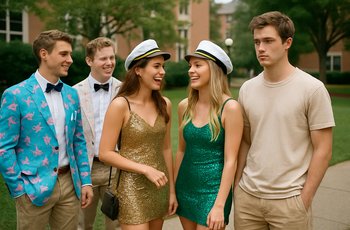
Decades themes. I know they've been done a million times but there's a reason for that. Everybody can participate, the costume range is huge, and nobody looks out of place. Our chapter did a 70s theme with Zeta Tau Alpha junior year and the effort level across the board was genuinely impressive. You had people fully committed to the bit - flared pants, the whole thing - and people who just threw on a headband and called it done. Both were valid. That flexibility is what makes a theme land.
Movies and TV show themes work for the same reason. Pick something with a big enough cast that everyone has options. Our Sigma Alpha Epsilon chapter did an Office-themed mixer once and it was perfect because there are enough characters that nobody was fighting over who got to be Jim. Somebody went as Toby. Voluntarily. That's commitment to the bit and honestly that guy won the night.
Color-coded themes - where each chapter gets a color - are criminally underused. Simple to execute, immediately creates a visual dynamic, and you don't have to explain your costume to anyone. Alpha Chi Omega and a few IFC chapters around us started doing these more and the photos always come out clean. There's something to be said for themes where the logistics don't collapse under their own weight.
The Themes That Sound Fun Until They Aren't
Anything that requires significant props or set construction should be approached with extreme caution. We once tried to do a carnival theme. Full carnival. Somebody had the vision of game booths and lights and the whole aesthetic. What we actually had was two folding tables, a string of lights that kept falling down, and a ring toss that nobody could win because the bottles were too light. The idea was great. The execution required resources we simply did not have on a chapter budget.
Overly specific pop culture references are a trap. If your theme requires someone to have watched a specific three-episode arc of a show that came out six months ago, you've already lost half the room. I've been to themed events where I genuinely could not figure out what the theme was until someone explained it to me in detail. That should not happen.
Anything that's kinda vague as a concept also falls apart fast. "Vibes" is not a theme. "80s but make it fashion" just means 80s. If the social chair can't explain the theme in one sentence, it needs another week of development before it goes on the calendar.
The Underrated Tier Nobody Talks About
Here's the thing about mixer themes - the ones people remember most aren't always the most elaborate. They're the ones with the best execution at the right scale.
Sports team themes are consistently underrated. Everyone has gear, everyone knows how to dress, and there's a natural energy that comes with it. Kappa Sigma did a college football theme one fall and it worked because it matched the season, it was low-pressure, and the coordination between both chapters was easy because the ask was simple.
Board games and game shows are another one that punches above its weight. Game show themes especially - you can actually run the format, involve both chapters, and it becomes interactive instead of everyone just standing around. Delta Delta Delta ran something like this a few years before I graduated and people were still talking about it by the time I was a senior. Not because of the costumes. Because something actually happened at the event.
The underrated secret of a good mixer theme is that it gives people something to do or talk about beyond the theme itself. Costumes are an icebreaker, not the whole event. Chapters that treat the theme as the foundation rather than the entire plan tend to have better mixers consistently.
What the Worst Themes Have in Common
Honestly, most bad mixer themes fail for the same two reasons. Either the idea was too ambitious for the budget and timeline, or the theme required too much specific knowledge to participate in comfortably. Both of those problems come from pitching ideas in the abstract without thinking through what it actually looks like when 60 people have to show up dressed for it.
The social chair job is harder than people give it credit for. You're trying to pick something that works for two different chapters with different vibes, different budgets, and different levels of commitment to costumes. Some people will go all out. Some people will show up and say they're "dressed as themselves but themed." A good mixer theme has to survive both of those people.
Pi Beta Phi's social team one year had a policy of testing every theme idea against the question: can someone pull this off with stuff they already own? It sounds like a low bar but it actually filtered out a lot of bad ideas before they made it onto the calendar. Most chapters would benefit from something like that.
There's no secret formula. But there's definitely a pattern - the themes that respect the practical limits of execution are almost always the ones that get remembered for the right reasons. And the ones that don't are the ones that become the chapter cautionary tale somebody still brings up two years later at alumni events.