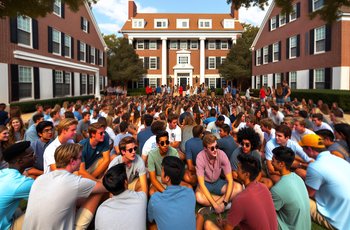

Nobody told me what it would actually be like. My boyfriend moved into the Sigma Chi house junior year and I spent enough time there - between dinners, study nights, and just hanging around - to get a pretty clear picture of the chaos that passes for daily life when thirty-something guys share one roof. And then my own brother pledged Kappa Sigma the following fall, so I got a front-row seat all over again. What I saw was not what the recruitment videos promised. It was louder, messier, more exhausting, and honestly? More human than I expected.
If you're about to move into a fraternity house, or you're already three weeks in and wondering if this was a mistake, this is the honest version of what nobody sat you down to explain.
The Noise Is Not the Hard Part
Everyone warns you about the noise. Doors slamming at 2 a.m., someone always watching something at full volume, the guy on the third floor who learned guitar approximately four months ago. Yes, that's all real. Buy earplugs. Get a white noise app. Done.
The harder thing - the thing that actually gets people - is the total collapse of personal space. Not physical space, though that's rough too. I mean the mental and emotional kind. When you live with thirty-plus people, you are never fully alone with your own thoughts. Someone always wants something. Someone always has a opinion about what you're doing, what you're eating, why you're in a bad mood. The group has a gravitational pull and it is constant.
My brother told me around week six that he'd stopped being able to tell which thoughts were actually his and which ones were just absorbed from whoever he'd been talking to that day. That sounds dramatic but I've heard versions of it from almost every guy I know who did house living. When you're that embedded in a group, individual identity gets slippery. The ones who came out of it with a strong sense of themselves were the ones who figured out how to protect some private space even when the house made that hard.
That means - practically speaking - having one or two things that are fully yours and not shared. A gym routine you do alone. A class no one else in the house is in. A hobby that has nothing to do with chapter business. It sounds small but it matters more than you'd think.
The Brotherhood Thing Is Real, But It's Earned
Here's the thing about 30-plus guys living together: the brotherhood that fraternities talk about in every single recruitment pitch is not automatic. You don't get it just by signing a bid card or paying dues. It develops through the friction of actually living with people you didn't choose and figuring out how to make it work anyway.
The Kappa Sigma chapter my brother joined had some genuine tension his first semester in the house. Two guys who clearly didn't like each other, a shared kitchen that was a disaster zone, chapter meetings that ran way too long and left everyone irritated. None of that was on the recruitment flyer. But by the end of that year, he trusted those guys in a way that surprised even him. Not because everything was smooth - because it wasn't - but because they had worked through enough actual conflict to know each other past the surface stuff.
The guys who struggled were the ones who came in expecting the feeling of brotherhood to just arrive. It doesn't arrive. You build it by showing up to help someone move furniture at 8 a.m., by not bailing on chapter responsibilities when you're tired, by being honest in a house meeting instead of just agreeing with whoever talks loudest. That's the actual work of it.
So if you're in the house and it doesn't feel the way the alumni told you it would feel - give it time and give it effort. And if it still doesn't feel right after a full year, that's also information worth having.
Sanity Is a System, Not a Feeling
You cannot rely on feeling like you have it together. In a fraternity house, the environment is not designed for stability. It is designed for maximum social activity at all times, which is fun right up until it isn't.
The guys I watched handle house living well all had something in common: they had structure that came from inside them, not from the house schedule. They knew when they were going to study before they got sucked into whatever was happening in the common room. They had a sense of what they needed - sleep, quiet, food that wasn't leftover pizza - and they actually went and got it instead of hoping it would happen.
Practically, that looks like a few things:
- Claim a physical spot that's yours. Whether that's your room, a specific library carrel, or a coffee shop three blocks away, you need somewhere that isn't the house.
- Have at least one person you can be honest with who lives outside the chapter. When the only people in your orbit are your brothers, it's easy to lose perspective fast.
- Don't treat chapter drama like it's your whole life. It isn't. It just feels that way when you live inside it.
- Know the difference between a bad week and a bad fit. Bad weeks are normal. Bad fit is worth taking seriously.
Living with that many people is going to push on you. It's gonna surface things about yourself you didn't know were there - some good, some less good. The ones who come out of house living as better, more grounded people are the ones who treated it as something to learn from rather than just something to survive.
That's not a given. It's a choice you have to keep making, over and over, usually when you're tired and the house is loud and you'd rather just numb out in front of a screen. But it's a choice that's worth making.