
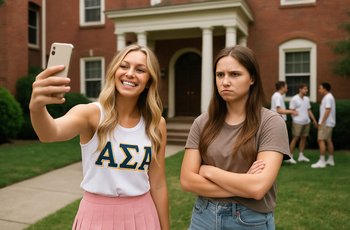
Every fall, thousands of PNMs walk into recruitment having already decided which chapter they want based on a 30-second TikTok. They've watched the aesthetic videos, they've seen the coordinated outfits, they've studied the comment sections like they're prepping for an exam. And by the time they show up for the first round of parties, they have a fully formed opinion about chapters they've never actually set foot in. That's a problem - and it's one Panhellenic governance is not even close to equipped to handle.
I'm not saying social media is new. I'm saying the specific way Greek life chapters now manage their online presence has created a recruitment environment that's fundamentally disconnected from what actually happens inside these organizations. The gap between the Instagram grid and the Google Doc chapter calendar is enormous. And the people who get hurt by that gap are the PNMs who chose a chapter based on vibes and a filter.
The Brand Is Not the Chapter
Here's the thing about Greek life content creation - it's almost never coming from the chapter as an institution. It's coming from two or three members who are good at making videos and enthusiastic about doing it. Which means what you're watching is their personal aesthetic, their friend group within the chapter, their version of what the organization looks and feels like. That's not dishonest exactly, but it's deeply incomplete.
I've sat in Panhellenic council meetings where chapters were flagged for recruitment violations because of things they posted online. The rules around recruitment communication are specific - most Panhellenic models follow NPC guidelines that restrict direct contact with PNMs during formal recruitment, and that absolutely includes social media. But enforcing that is a nightmare. What counts as a recruitment post versus just a regular post? If Kappa Kappa Gamma puts up a video of sisterhood events during recruitment week, is that a violation? These questions were not written into policy for an era of algorithmic content delivery.
And meanwhile, the chapters that are good at TikTok are pulling name recognition that has nothing to do with campus standing. I've watched chapters that were sitting on academic probation get flooded with first-choice rankings because someone in the chapter knew how to use a trending audio. That's not a recruitment process. That's a marketing contest.
What PNMs Actually Think They Know
Talk to a PNM during recruitment and ask her what she knows about the chapters she's rushing. She'll tell you about the vibe, the aesthetic, who seems fun. Ask her about chapter GPA, philanthropic hours, housing conditions, alumni involvement, chapter size - blank stare. She's not uninformed because she didn't try. She's uninformed because the information that's easy to find is the information chapters chose to surface, and chapters chose to surface content that photographs well.
Zeta Tau Alpha might have an incredible chapter on your campus with strong academics and a genuinely close sisterhood. But if their social media presence is low-effort compared to the chapter next door, they're gonna lose rankings to an organization running a better content strategy. That is backwards. That is not what any of us got into this for.
Honestly, the NPC's whole push toward values-based recruitment sounds great in theory. It's the official line, it's what every Panhellenic orientation script says, it's what gets repeated in every rho gamma training. But values don't go viral. Choreographed bid day reels do.
The Governance Side Can't Keep Up
I want to be fair here. The people running campus Panhellenic councils are mostly juniors and seniors who are doing their best with a policy framework that was built for a different era. The Judicial Board processes I worked through were designed to handle clear violations - a chapter talking to a PNM off-script, a bid being extended outside the formal offer period. They were not designed to handle a chapter growing its reputation entirely through content that technically doesn't break any rule.
And national organizations are not helping. Most of them are pushing chapters to build stronger social media presences. Some have full-time staff dedicated to brand and communications. Alpha Chi Omega, Delta Delta Delta, Pi Beta Phi - the nationals all have style guides and content frameworks now. Which is fine, except it accelerates the exact problem I'm describing. It professionalizes a chapter's ability to look appealing online without doing anything to make the chapter actually better.
The result is a recruitment process where the chapters with the most resources for content creation - which often means the wealthiest chapters at the top of the social tier - maintain their advantage not because they're offering PNMs something real, but because they can afford to keep the illusion going at scale.
What Would Actually Help
I'm not calling for a social media ban. That's not realistic and it's not the point. But a few things would genuinely shift the dynamic.
Panhellenic councils should require chapters to publish standardized data alongside their public-facing profiles - chapter GPA, new member retention rates, philanthropic hours from the previous year. Not buried in some corner of the campus Greek life website. Front and center, updated every semester, findable. If you're going to let chapters compete on brand, at least give PNMs something real to compare them against.
Some councils have started requiring rho gammas to actively tell PNMs to go look up chapter standing reports before they submit their final preference lists. That's a small thing but it matters. It reframes what doing your research actually looks like.
And chapters need to have an internal conversation about what they're actually communicating. A Sigma Chi pledge class that was chosen based on a highlight reel is gonna have a fundamentally different experience than a pledge class that came in knowing what the chapter actually is. Retention problems, expectation mismatches, early drops - a lot of that traces back to the beginning. To the gap between the content and the reality.
The video where everyone looks perfect and the bid day energy is contagious - that's not nothing. But it's a moment. And chapters are not moments. They're organizations with histories and cultures and problems and people who are genuinely trying. None of that fits in 30 seconds, and until we figure out how to close that gap, we're recruiting for the wrong things.